

The 2003 science fiction disaster film The Core has emerged as a significant case study in the power of digital distribution, achieving a remarkable resurgence in viewership decades after its initial theatrical failure. Despite being historically dismissed by critics and ridiculed by the scientific community for its flagrant disregard for the laws of physics, the film has found a robust second life on Netflix. However, this period of accessibility is drawing to a close, as the title is scheduled to depart the streaming platform’s library on September 5, 2026. This departure marks the end of a multi-year cycle where the film transitioned from a box-office "bomb" to a trending digital success, particularly noted for its peak performance in April 2025.
A Premise Built on Seismic Stakes
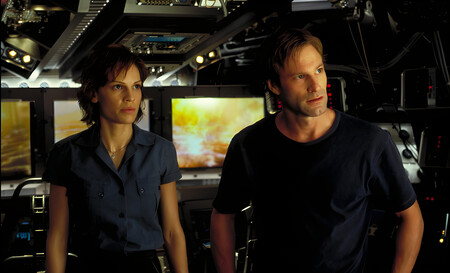
Directed by Jon Amiel and featuring an ensemble cast including Aaron Eckhart, Hilary Swank, Stanley Tucci, and Delroy Lindo, The Core presents a high-stakes narrative centered on a global catastrophe. The plot is set in motion when a series of unexplained phenomena begin to occur across the globe: people with pacemakers drop dead simultaneously, pigeons lose their ability to navigate and crash into buildings, and the Aurora Borealis appears in lower latitudes.
The fictional premise posits that the Earth’s inner core has stopped rotating. This cessation of movement leads to the rapid decay of the planet’s electromagnetic field, which protects the Earth from lethal solar radiation. Without this shield, the atmosphere would eventually be "cooked" by microwaves, leading to total extinction. To avert this, a team of "terranauts" is assembled to pilot a vessel made of a fictional heat-resistant material called "Unobtainium" to the center of the Earth. Their mission is to use a series of nuclear detonations to jump-start the core’s rotation.

While the film follows the traditional beats of the disaster genre—including the assembly of a team of experts, the construction of a miraculous vehicle, and the inevitable heroic sacrifices—it distinguishes itself through the sheer audacity of its pseudo-scientific explanations. It is this specific quality that has fueled both its initial downfall and its eventual status as a cult favorite.
The Financial Landscape and 2003 Box Office Context
The Core was released on March 28, 2003, during an era when big-budget disaster movies were a staple of Hollywood’s output. Following in the footsteps of late-90s blockbusters like Armageddon and Deep Impact, Paramount Pictures invested heavily in the production, with a budget estimated at $115 million. This was a significant sum at the time, intended to cover the extensive visual effects required to depict the Earth’s interior and various global disasters.
However, the film’s theatrical run was largely unsuccessful. It earned approximately $31 million domestically and finished its global run with roughly $79 million. When accounting for marketing costs and theater splits, the film represented a substantial financial loss for the studio. Industry analysts at the time attributed this failure to several factors:
- Genre Fatigue: By 2003, audiences had grown weary of the "team saves the world from a natural disaster" trope.
- Stiff Competition: The film faced significant competition from other early-year releases and upcoming summer blockbusters.
- Critical Reception: Critics were largely unkind, often focusing on the wooden dialogue and the increasingly absurd plot points that strained even the most generous "suspension of disbelief."
Despite these hurdles, the film maintained a presence in home media, eventually laying the groundwork for its eventual transition into the streaming era.

Scientific Inaccuracy as a Pedagogical Tool
Perhaps the most enduring legacy of The Core is its reputation among scientists. While many science fiction films take liberties with reality, The Core is frequently cited by experts as one of the most scientifically inaccurate films ever produced. This notoriety reached a level where NASA reportedly identified it as one of the most "absurd" films in the genre, alongside the 2009 film 2012.
The scientific community’s objections are rooted in fundamental geophysics. The film’s portrayal of the Earth’s interior—depicting massive open geodes and liquid magma that behaves like water—contradicts the reality of extreme pressure and density found at the planet’s core. Furthermore, the concept of "Unobtainium," a metal that converts heat and pressure into energy to strengthen itself, is a direct violation of the second law of thermodynamics.
Interestingly, this lack of accuracy has given the film a unique educational value. At the University of British Columbia (UBC) in Vancouver, the film has been integrated into the curriculum for Earth and Ocean Sciences. Professors use the film as a "reverse-teaching" tool. Students are tasked with watching the film and identifying as many scientific errors as possible, covering topics such as:
- Seismic Wave Propagation: How sound and vibrations actually move through the Earth.
- Electromagnetism: The true nature of the Earth’s dynamo and why it cannot simply "stop" rotating due to human activity or internal friction.
- Fluid Dynamics: The behavior of molten iron and nickel under millions of atmospheres of pressure.
- Atmospheric Science: The actual effects of solar radiation and the functionality of the Van Allen belts.
By analyzing what the film gets wrong, students gain a deeper understanding of what is actually true about planetary science. This academic "hate-watching" has contributed to the film’s longevity, ensuring it remains a topic of discussion in classrooms and online forums.
The Streaming Phenomenon and the Second Life of Cinema
The resurgence of The Core on Netflix in the mid-2020s highlights a broader trend in the entertainment industry: the "Streaming Second Life." This phenomenon occurs when a film that was ignored or maligned during its theatrical release is rediscovered by a new generation of viewers through algorithmic recommendations.
In April 2025, The Core climbed into the top ten most-watched movies on Netflix in several regions. Data suggests that modern audiences often approach the film not as a serious drama, but as "comfort food" cinema—highly entertaining, visually stimulating, and easy to watch. The very elements that critics hated in 2003—the melodrama, the impossible physics, and the over-the-top acting—have become the features that streaming audiences find endearing.
The film’s success on streaming platforms can also be attributed to the "so bad it’s good" subculture. Much like The Room or Sharknado, The Core is celebrated for its earnestness. Unlike modern "meta" comedies that wink at the audience, The Core plays its absurd premise entirely straight, which many viewers find more engaging than modern, self-aware blockbusters.
Chronology of a Cult Classic
To understand the trajectory of The Core, it is helpful to look at the timeline of its evolution from a studio disaster to a streaming staple:

- March 2003: The Core is released in theaters to poor reviews and weak box office numbers.
- 2004–2010: The film becomes a staple of cable television broadcasts and DVD bargain bins, slowly building a "guilty pleasure" following.
- 2011: NASA scientists, during a symposium, jokingly label the film as the "least scientifically accurate" movie ever made, sparking a new wave of internet interest.
- 2015–2020: Educational institutions like UBC formalize the use of the film as a pedagogical tool for geology students.
- April 2025: The film experiences a massive spike in viewership on Netflix, reaching the platform’s "Top 10" list 22 years after its release.
- August 2026: Netflix announces the removal of the film from its library.
- September 5, 2026: The Core is scheduled to leave Netflix, ending its most successful digital run to date.
Broader Implications and Industry Reactions
The enduring popularity of The Core suggests that there is a permanent market for "high-concept" disaster fiction, regardless of its relationship with reality. While contemporary filmmakers often hire scientific consultants to ensure accuracy (as seen in films like Interstellar or The Martian), The Core stands as a reminder of an era where spectacle took absolute precedence over logic.
Industry analysts suggest that the film’s streaming success may influence how studios value their back catalogs. Older films that were once considered liabilities are now being viewed as valuable assets that can provide low-cost engagement for streaming subscribers. Furthermore, the film’s "educational" notoriety has provided a form of free, perpetual marketing that keeps the title relevant in the public consciousness.
As the September 5, 2026, deadline approaches, the film is expected to see one final surge in viewership as fans and curious newcomers rush to experience the "perfect example of what never to do in science." Whether viewed as a cautionary tale for screenwriters or a beloved piece of nostalgic kitsch, The Core has secured its place in cinematic history, not for its excellence, but for its spectacular, entertaining defiance of the world as we know it.

0 Comments