
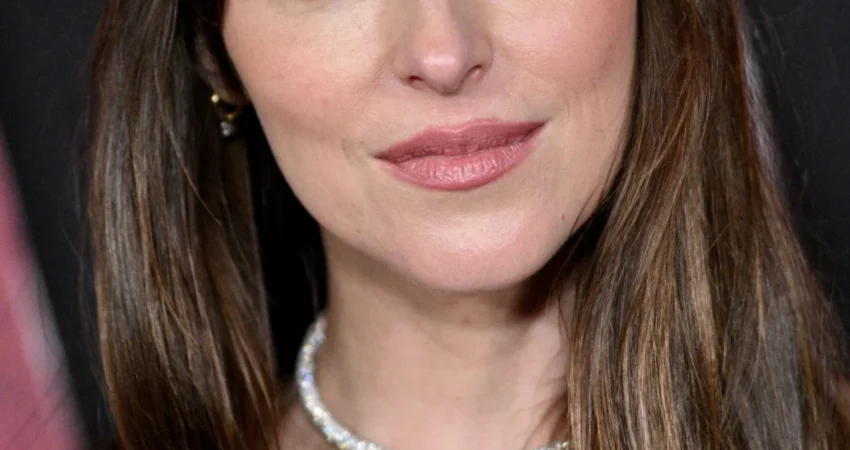
The cultural impact of Dakota Johnson’s aesthetic choices has reached a new peak as her signature fringe once again dominates the global beauty discourse, positioning itself as the definitive hair trend for the Autumn-Winter 2026 season. Since her international breakthrough in the 2015 film Fifty Shades of Grey, Johnson’s hair has served as a primary point of reference for stylists and clients worldwide, yet its current resurgence is fueled by a convergence of high-profile cinematic projects, musical collaborations, and a definitive shift in runway aesthetics. With the upcoming release of the psychological thriller Verity—in which she stars alongside Academy Award winner Anne Hathaway and Josh Hartnett—and her recent appearance in the "Patient Zero" music video from Taylor Swift’s The Life of a Showgirl encore, the actress has solidified her role as a perennial muse for the modern era.
Historical Context and the "Johnson Effect"
The phenomenon often referred to by industry insiders as the "Johnson Effect" began over a decade ago. While many celebrities undergo frequent and radical transformations, Dakota Johnson has maintained a remarkably consistent visual identity, centered almost exclusively on her versatile forehead-skimming bangs. This consistency has transformed a simple haircut into a brand hallmark. Historically, the fringe has been a symbol of French chic—evoking icons like Jane Birkin and Françoise Hardy—but Johnson modernized the look by introducing a deliberate "undone" quality that appeals to a broader, more casual demographic.
The timeline of this hairstyle’s evolution shows a transition from the heavy, blunt cuts of the mid-2010s to the more layered, "bottleneck" styles of the early 2020s. By 2026, the trend has moved toward a highly adaptable "chameleon fringe" that can be parted, tucked, or textured depending on the occasion. This adaptability is central to why the style remains relevant; it offers a low-commitment way to alter one’s facial proportions without the permanence of a short crop or the maintenance of complex coloring.

Runway Validation and the 2026 Designer Perspective
The resurgence of the fringe is not merely a celebrity-driven fad but is deeply rooted in the strategic directions of major fashion houses. For the Autumn-Winter 2026 collections, several Tier-1 designers have integrated variations of the fringe into their runway presentations, providing a formal endorsement of the look.
At Balenciaga and Chanel, the focus has shifted toward the "Micro-Fringe." Often paired with pixie cuts or severe bobs, this version is avant-garde and architectural, designed to highlight the brow bone and create a sharp, editorial silhouette. Conversely, designers such as Collina Strada, Louis Vuitton, and Erdem have opted for a "Textured and Effortless" approach. Their models showcased fringes with uneven lengths and matte finishes, suggesting a move away from the high-gloss perfection of previous years.
In a nostalgic turn, Alexander McQueen and Christian Dior have revisited the early 2000s, reintroducing the "Side-Swept Fringe." This style, which leans heavily on asymmetry, provides a softer alternative for those wary of the bluntness of a traditional front-facing cut. Meanwhile, the "French Fringe" remains a staple at Chloé and Eckhaus Latta, emphasizing long, wispy strands that graze the eyelashes, a direct homage to 1970s bohemianism. Finally, the "Shag Fringe," seen at Simone Rocha and Valentino, draws inspiration from rock-and-roll icons like Jane Fonda and Linda McCartney, utilizing heavy layering to create volume and movement.
The Technical Framework: Determining Suitability
As the demand for fringes surges in salons, beauty experts and dermatologists have highlighted the importance of facial geometry in determining the success of the cut. The most prominent analytical tool currently circulating in the industry is the "Rule of Three" or the "Three-Finger Rule." This viral diagnostic method allows individuals to assess their facial proportions to predict how a fringe will interact with their features.

The Rule of Three involves a three-step measurement process:
- Forehead Width: By placing fingers horizontally across the forehead, individuals categorize their forehead height. A three-finger width (Category 1) suggests a smaller canvas, while five fingers (Category 3) indicates a high forehead that is often balanced effectively by a heavy fringe.
- Facial Width Analysis: Identifying the widest point of the face—be it the forehead (1), cheeks (2), or jawline (3)—is crucial for determining where the fringe should terminate to avoid over-emphasizing width.
- Inter-Ocular Distance: Comparing the space between the eyebrows to the width of a single eye helps stylists decide whether a fringe should be "open" (curtain style) or "closed" (blunt style) to properly frame the eyes.
According to industry data, certain numerical codes derived from this test—such as 222, 321, and 312—suggest a high probability of aesthetic success with a fringe. Conversely, codes like 111 or 231 may indicate that a fringe could crowd the face, suggesting that a more "open" or lateral style would be more flattering.
Face Shape Taxonomy and Customization
The versatility of the Dakota Johnson fringe lies in its ability to be customized to specific bone structures. While Johnson possesses an oval face—the most versatile shape in hair design—stylists have developed protocols for other categories:
- Round Faces: To avoid shortening the face, experts recommend a lateral or "curtain" fringe. By creating a central or side opening, the cut adds verticality, effectively elongating the appearance of the face.
- Square Faces: The goal is to soften the angularity of the jaw. A long, layered fringe that blends into the side lengths can break up the "boxiness" of the facial frame.
- Elongated or Rectangular Faces: A thick, blunt fringe acts as a visual "stop," effectively shortening the face and creating a more balanced, harmonious proportion.
- Heart or Inverted Triangle Faces: A wispy, side-swept fringe can minimize a wider forehead while drawing attention to the eyes and softening a pointed chin.
Texture, Maintenance, and the DIY Movement
A significant factor in the current trend is the shift toward "authentic texture." Dakota Johnson has famously admitted in interviews to trimming her own bangs, a revelation that has humanized the high-fashion look. This "DIY" ethos has encouraged a generation of consumers to embrace imperfections. However, professional stylists warn that hair texture remains the primary obstacle to achieving the desired result.

For individuals with wavy or curly hair, the "shrinkage factor" is a critical consideration. Hair must be cut dry to ensure the length remains stable once the natural curl pattern asserts itself. Furthermore, those with "cowlicks" or strong growth patterns at the hairline may find a blunt fringe difficult to manage without daily heat styling. In response, the 2026 hair care market has seen a 15% increase in the production of "fringe-specific" styling tools, including mini-flat irons and lightweight dry shampoos designed to prevent the bangs from becoming oily against the skin.
Broader Implications and the Digital Influence
The resurgence of the fringe also highlights the growing role of Augmented Reality (AR) in the beauty industry. Before committing to a physical cut, millions of consumers are now using "fringe simulators" on social media platforms. These AI-driven filters allow users to overlay various fringe styles onto their real-time video feed, significantly reducing the "buyer’s remorse" often associated with radical hair changes.
From a market perspective, the "Dakota Johnson Fringe" represents more than just a style; it is a driver of economic activity within the salon industry. Reports from major beauty conglomerates suggest that "fringe maintenance" appointments—quick, 15-minute trims—have become a significant revenue stream, fostering greater client loyalty and more frequent salon visits.
Conclusion: The Future of the Fringe
As we move deeper into the Autumn-Winter 2026 season, the influence of Dakota Johnson’s aesthetic remains undeniable. Her ability to bridge the gap between Hollywood glamour and relatability has made the fringe a symbol of modern femininity. Whether it is the architectural micro-fringe of the Paris runways or the "shaggy" DIY look favored by the actress herself, the message from the fashion world is clear: the fringe is not just a haircut, but a strategic tool for self-expression. By combining mathematical precision with a respect for natural hair texture, the industry has ensured that this trend remains accessible, versatile, and, above all, enduring. The "Verity" era of Dakota Johnson’s career may be defined by her performance on screen, but her contribution to the global visual landscape will undoubtedly be remembered through the iconic silhouette of her hair.

0 Comments