
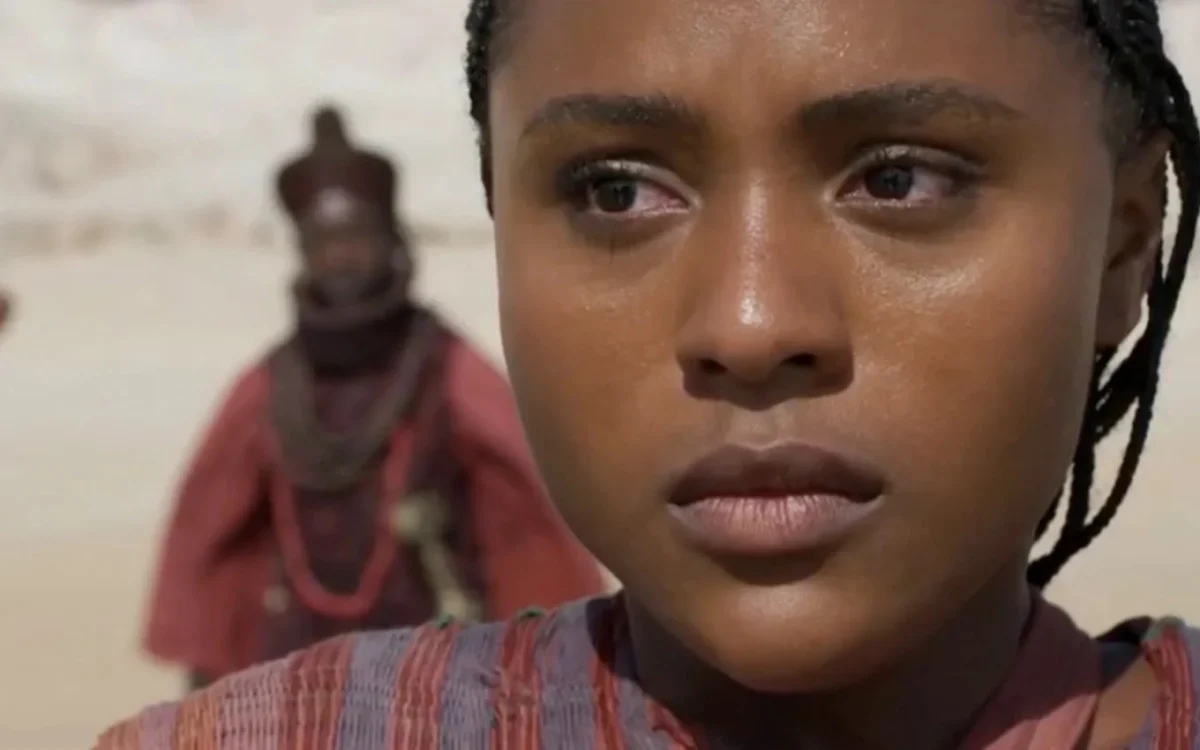
The highly anticipated and pivotal encounter between Princess Alika, portrayed by the acclaimed Duda Santos, and the unassuming Tonho, played by Ronald Sotto, has become a cornerstone moment in the unfolding narrative of the six o’clock telenovela, “A Nobreza do Amor.” This dramatic first meeting, far removed from the idealized romantic tropes often seen on screen, unfolds amidst a backdrop of political upheaval, cultural displacement, and personal vulnerability, laying the groundwork for a saga of love, destiny, and social justice.
A Kingdom in Turmoil: The Flight of Princess Alika
The narrative arc for Princess Alika begins in the fictional West African kingdom of Batanga, a land depicted as rich in history, culture, and natural resources, but now gripped by the tyrannical rule of Jendal, portrayed with menacing intensity by Lázaro Ramos. Alika’s perilous journey to Brazil is not merely an escape but a desperate flight for survival, triggered by the tragic and untimely death of her father, King Cayman. The king, a benevolent and revered ruler, was a victim of Jendal’s ruthless coup, which plunged Batanga into an era of oppression and instability. Sources within the production team indicate that the writers meticulously crafted Batanga’s history, drawing inspiration from various African monarchies to create a believable and culturally rich backdrop, emphasizing its vibrant traditions and the profound sense of loss experienced by its people under Jendal’s iron fist. The political machinations and the ensuing power struggle are central to Alika’s backstory, providing a compelling motivation for her drastic relocation.
Alika’s escape was a clandestine operation, meticulously planned by loyalists who understood the existential threat she faced as the rightful heir. Her journey was fraught with danger, underscoring the severity of Jendal’s pursuit and the high stakes involved. She arrived on Brazilian soil not with the retinue and fanfare befitting royalty, but in arduous and clandestine circumstances, stripped of her royal protections and immersed in an unfamiliar world. This immediate immersion into a drastically different reality serves as the catalyst for her profound culture shock and subsequent character development.
Chronology of Displacement: From Palace to Peril
The events leading to Alika’s arrival in Brazil can be traced back to a series of escalating tensions in Batanga. King Cayman, known for his progressive policies and deep connection to his people, had been attempting to modernize the kingdom while preserving its ancient customs. Jendal, his ambitious and power-hungry cousin, capitalized on burgeoning internal political factions and exploited the kingdom’s resource wealth for his own gain, steadily consolidating power. The production team, led by director Amora Mautner, collaborated with cultural consultants to ensure the authenticity of Batangan customs and political dynamics, portraying Jendal’s takeover as a tragic betrayal of the kingdom’s heritage.
The coup itself was depicted as swift and brutal, culminating in King Cayman’s assassination. This pivotal event, which aired in the opening week of the novela, sent shockwaves through the fictional Batangan populace and set the emotional tone for Alika’s subsequent plight. Her escape, aided by loyal retainers, was a race against time, involving covert travel through multiple countries before securing passage to Brazil. This period of clandestine travel, though briefly shown on screen, is rich with implied hardship, loss, and the constant threat of discovery, transforming Alika from a sheltered princess into a resilient, albeit vulnerable, fugitive. Her decision to adopt the alias "Lúcia" upon arrival in Brazil further highlights her desperation to evade Jendal’s reach and blend into the local population.
A Collision of Worlds: Alika and Tonho’s Unconventional Introduction
The pivotal first encounter between Alika and Tonho occurs not in a grand ballroom or a romantic setting, but amidst the bustling, unpretentious environment of Barro Preto, a vibrant and close-knit community in Brazil. This setting immediately establishes the vast social and cultural chasm separating the two protagonists. Alika, accustomed to the stringent protocols and formal elegance of an African royal court, finds herself utterly disoriented by the informality and directness of Brazilian life, particularly as embodied by Tonho. Her initial reaction, a blend of indignation and profound "strangeness," is a testament to the depth of her cultural shock. She views Tonho’s forthright demeanor and lack of deference as "impertinent," a stark contrast to the respectful interactions she has known her entire life.
Tonho, on the other hand, is portrayed as the quintessential "man of the people" – hardworking, honest, and grounded in the realities of his community. He is depicted as a pragmatic individual, unburdened by social pretenses, who approaches the distressed "Lúcia" with genuine concern but also with the practical, no-nonsense attitude typical of his background. The humor and dramatic tension in their initial interactions stem precisely from this collision of vastly different worlds. Tonho, completely unaware of Alika’s royal lineage, perceives her as an unusually haughty and demanding foreigner in need of assistance, while Alika struggles to reconcile his perceived impudence with his underlying generosity. This dynamic is a deliberate narrative choice by the show’s creators to establish an immediate, albeit rocky, chemistry that promises significant character growth for both.
Character Portrayals and Creative Vision
Duda Santos, in her role as Princess Alika/Lúcia, has received early critical acclaim for her nuanced portrayal of a character navigating immense personal trauma and cultural displacement. Her performance effectively conveys the princess’s inherent nobility, her regal bearing, but also her deep vulnerability and the struggles associated with adapting to an entirely new way of life. Industry insiders suggest Santos underwent extensive training, including cultural immersion workshops and language coaching, to authentically embody Alika’s Batangan heritage.
Ronald Sotto’s Tonho is lauded for bringing a refreshing authenticity and warmth to the character. Sotto reportedly spent time observing local communities to capture the essence of a "man of the people," ensuring Tonho felt genuine and relatable. His portrayal grounds the fantastical elements of Alika’s story in a tangible Brazilian reality, making the cultural clash all the more impactful.
Lázaro Ramos’s Jendal is shaping up to be one of the most compelling antagonists in recent telenovela history. Ramos’s ability to imbue the character with both charisma and chilling ruthlessness makes Jendal a formidable threat, whose shadow looms large over Alika’s Brazilian refuge. The casting choices reflect a deliberate effort by Globo to bring together a diverse and highly talented ensemble, ensuring strong performances across the board.
Beyond the Initial Spark: A Seed of Destiny
Despite the initial friction and Alika’s palpable irritation, this seemingly discordant encounter proves to be profoundly decisive. It is Tonho, the "atrevido" young man, who, despite Alika’s standoffishness, offers genuine assistance to her and her mother, Niara, in their quest to locate José, Alika’s uncle who resides in Brazil. This act of generosity, extended without expectation or knowledge of her true identity, plants the crucial seed for a deeper connection, one that the venerable Dona Menina has already prophesied as spiritual and ancestral.
Dona Menina, a character embodying the wisdom and spiritual guidance within the narrative, represents the mystical thread woven throughout “A Nobreza do Amor.” Her prophecy of a "love of destiny" elevates the initial romantic premise into something far more profound, suggesting a preordained connection that transcends social barriers and cultural differences. This spiritual dimension is a common trope in Brazilian telenovelas but is here given a fresh interpretation through the cross-cultural lens of Batangan and Brazilian mysticism. The production team consulted with ethnographers and spiritual leaders to respectfully integrate these elements into the storyline, ensuring they resonate authentically with the narrative’s themes.
Broader Implications: Love, Justice, and Cultural Understanding
The burgeoning relationship between Alika and Tonho is not merely a romantic entanglement; it is poised to become a powerful allegory for unity, resilience, and the fight against injustice on multiple fronts. The discomfort and "estranheza" that initially define their interactions are designed to mask a profound, deeper connection that will compel them to unite against the injustices plaguing both Tonho’s community in Brazil and Alika’s besieged kingdom of Batanga. This dual struggle is a core thematic element of the novela, aiming to address issues of social inequality, political corruption, and cultural prejudice within both contexts.
The narrative arc promises a significant journey of maturation for Princess Alika. She will be compelled to shed the trappings of her royal upbringing and descend from her perceived "pedestal" to truly understand the world beyond the palace walls. This descent is not a diminishment of her nobility but rather a transformative process through which she discovers the true essence of nobility in the heart of a commoner – Tonho. Her experiences in Brazil, particularly her interactions with Tonho and his community, are intended to broaden her perspective, instill humility, and equip her with the empathy and understanding necessary to become a more effective and compassionate leader, should she ever reclaim her rightful place in Batanga.
Furthermore, "A Nobreza do Amor" aims to explore themes of cultural exchange and the beauty found in diversity. By juxtaposing African royalty with Brazilian rural life, the novela seeks to highlight the richness of both cultures while challenging preconceived notions and stereotypes. The show’s writers have indicated their intention to use the romance as a vehicle to discuss complex issues such as post-colonial identity, the impact of tyranny, and the universal human desire for freedom and justice.
Audience Reception and Social Commentary
Since its premiere, "A Nobreza do Amor" has garnered significant attention from both critics and the public. Early viewership figures indicate a strong performance in its time slot, suggesting that the blend of romance, drama, and social commentary has resonated with audiences. Social media platforms are abuzz with discussions about the cultural dynamics between Alika and Tonho, the political intrigue in Batanga, and the stellar performances of the main cast.
Cultural commentators have praised the novela for its ambitious scope and its willingness to tackle complex geopolitical themes within the popular format of a romantic drama. Many see it as a progressive step in Brazilian television, offering a fresh perspective on cross-cultural relationships and global issues. The initial clash between Alika and Tonho, rather than being a deterrent, has been lauded as a realistic and engaging way to kickstart a potentially profound love story, one that promises not only emotional depth but also intellectual stimulation. The series is poised to become a significant talking point, sparking conversations about identity, belonging, and the enduring power of human connection across seemingly insurmountable divides. As the story of Alika and Tonho unfolds, viewers are eager to witness how their destined love will navigate the challenges ahead and ultimately contribute to the fight for a more just world, both in the vibrant heart of Brazil and the distant, troubled kingdom of Batanga.

0 Comments