
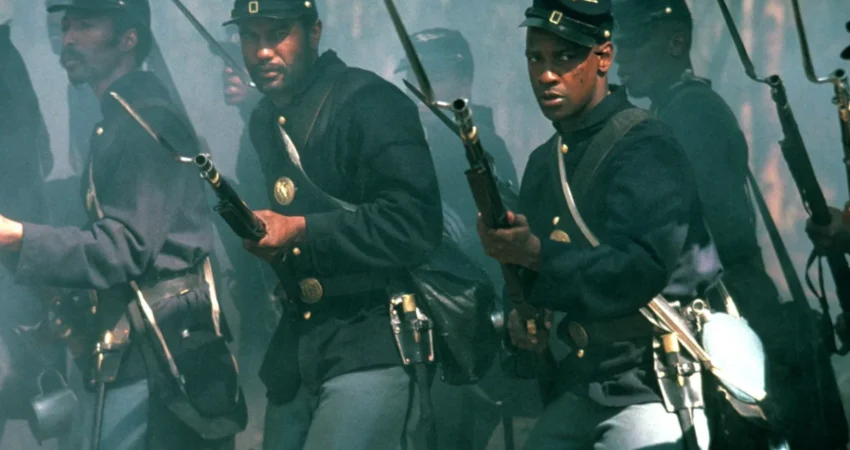
The 1989 film Glory, directed by Edward Zwick, remains one of the most profound and emotionally resonant war dramas produced in the last four decades. Featuring a prestigious ensemble cast that includes Matthew Broderick, Denzel Washington, Morgan Freeman, and Cary Elwes, the production serves as both a harrowing depiction of the American Civil War and a tribute to the African American soldiers who fought for a country that had yet to fully acknowledge their humanity. Set against the backdrop of 1863, the narrative follows the formation and deployment of the 54th Massachusetts Volunteer Infantry, the first all-Black regiment in the Union Army. Through its meticulous attention to historical detail and visceral storytelling, Glory transcends the traditional boundaries of the war genre, offering a complex exploration of identity, sacrifice, and the arduous pursuit of dignity.
Historical Foundations: The 54th Massachusetts Volunteer Infantry
To understand the weight of the narrative presented in Glory, one must examine the historical reality of the 54th Massachusetts Volunteer Infantry. Following the issuance of the Emancipation Proclamation by President Abraham Lincoln, the Union began the controversial process of recruiting Black soldiers. The 54th was a "social experiment" of sorts, championed by Governor John A. Andrew of Massachusetts and prominent abolitionists like Frederick Douglass. Douglass, whose own sons Lewis and Charles joined the regiment, viewed military service as a vital pathway to citizenship and legal equality.
The film focuses on the leadership of Colonel Robert Gould Shaw, portrayed by Matthew Broderick. In reality, Shaw was the 25-year-old son of wealthy Boston abolitionists who initially hesitated to take command. The historical Shaw was tasked with transforming a group of former slaves and free men into a disciplined fighting force. This process was fraught with systemic challenges; Black soldiers were initially paid less than their white counterparts—ten dollars a month minus a clothing fee, compared to the thirteen dollars plus clothing provided to white troops. The 54th famously refused all pay until the discrepancy was rectified, a moment of collective protest that the film highlights to emphasize the soldiers’ commitment to honor over financial gain.
The Vision of Edward Zwick and the Production Process
Director Edward Zwick, working from a screenplay by Kevin Jarre, drew inspiration from several primary sources, including the personal letters of Robert Gould Shaw and the books Lay This Laurel by Lincoln Kirstein and One Gallant Rush by Peter Burchard. The production was marked by a commitment to authenticity that was rare for its time. To recreate the large-scale skirmishes and the climactic assault on Fort Wagner, the production utilized over 1,500 Civil War reenactors. These volunteers brought their own equipment and a deep knowledge of 19th-century military tactics, providing the film with a level of period accuracy that resonated with historians and audiences alike.
The cinematography, helmed by Freddie Francis, utilized a naturalistic lighting palette that captured the grime and brutality of the 19th-century battlefield. Francis’s work was instrumental in contrasting the rigid, formal world of the military hierarchy with the raw, untamed chaos of combat. Furthermore, the film’s pacing allows for quiet, character-driven moments that build the emotional stakes, ensuring that when the violence eventually erupts, it carries significant weight.

A Performance for the Ages: Denzel Washington and the Struggle for Dignity
While the film is structured around the perspective of Colonel Shaw, its emotional core is undeniably anchored by the performances of the soldiers within the ranks. Denzel Washington’s portrayal of Silas Trip, a defiant and cynical fugitive slave, earned him his first Academy Award for Best Supporting Actor. Trip serves as the ideological foil to the more composed Sergeant Major John Rawlins, played by Morgan Freeman. Their dynamic illustrates the internal diversity of the Black experience during the era—ranging from Rawlins’s weary wisdom and belief in incremental progress to Trip’s justified rage against a system that continues to oppress him even as he fights for its survival.
One of the most pivotal moments in cinematic history occurs when Trip is subjected to a military flogging for desertion—a charge resulting from his search for a pair of boots, as the regiment had been denied proper supplies. During the filming of this sequence, Washington remained in character throughout the entire process, maintaining a stoic silence that amplified the scene’s intensity. Director Edward Zwick recounted that he instructed the cinematographer to keep the cameras rolling to capture the raw, unscripted evolution of Washington’s performance. The result was a single, spontaneous tear that fell from Washington’s eye—a moment that Zwick described as one of the most powerful things he had ever witnessed on a film set. This scene effectively encapsulated the central theme of the movie: the agonizing struggle to maintain one’s soul in the face of dehumanizing circumstances.
Technical Achievement and the Score of James Horner
Beyond the acting, the film is elevated by the haunting and triumphant score composed by James Horner, featuring the Boys Choir of Harlem. The music serves as a spiritual bridge, connecting the individual struggles of the soldiers to the broader, almost mythic significance of their mission. Horner’s use of choral arrangements during the final march toward Fort Wagner creates a sense of inevitable tragedy and transcendent heroism, guiding the audience through the film’s devastating conclusion.
The technical prowess of Glory extended to its sound design, which won an Academy Award. The auditory landscape of the film—the rhythmic thud of marching boots, the sharp crack of Enfield rifles, and the thunderous roar of cannons—immerses the viewer in the sensory overload of Civil War combat. This attention to detail ensured that the film was not merely a historical reenactment but a visceral experience that forced audiences to confront the physical reality of the war.
Reception, Awards, and Statistical Milestones
Upon its release on December 14, 1989, Glory received widespread critical acclaim. It currently holds a 95% "Certified Fresh" rating on Rotten Tomatoes, with critics praising it as one of the finest war films ever made. While its initial box office performance was modest—earning approximately $26.8 million against an $18 million budget—its reputation grew exponentially through home media and educational use, eventually becoming a staple in American history curricula.
At the 62nd Academy Awards, the film was nominated for five Oscars and won three:
- Best Supporting Actor: Denzel Washington
- Best Cinematography: Freddie Francis
- Best Sound: Donald O. Mitchell, Gregg Landaker, Elliot Tyson, and Russell Williams II
The film’s success signaled a shift in Hollywood’s approach to historical narratives, proving that there was a significant audience for stories that centered on the contributions of marginalized groups in American history.
The Enduring Impact on American Historical Narrative
The legacy of Glory extends far beyond the realm of entertainment. For many Americans, the film served as their first introduction to the existence of Black soldiers in the Civil War. By the end of the conflict, roughly 180,000 Black men had served in the Union Army, making up about 10% of the total force. President Abraham Lincoln famously credited these troops with turning the tide of the war, stating that without their contribution, the Union might not have prevailed.
Glory challenged the "Lost Cause" mythology—a pseudo-historical narrative that attempted to downplay the role of slavery and Black agency in the Civil War. By focusing on the 54th Massachusetts, the film reclaimed a vital chapter of American history, highlighting the paradox of men fighting for a "New Birth of Freedom" while still facing prejudice from their own commanders and the Union public. The film’s ending, depicting the unsuccessful but heroic assault on Fort Wagner in South Carolina, emphasizes that their victory was not measured in territory gained, but in the undeniable proof of their courage and capability.
Availability and Contemporary Significance
As the film celebrates over three decades since its release, its themes of racial justice and the fight for recognition remain strikingly relevant. The depiction of systemic inequality within the military—ranging from the denial of supplies to the threat of execution if captured by the Confederacy—continues to resonate in contemporary discussions regarding institutional bias.
For those looking to revisit or experience this classic for the first time, Glory is currently available for digital rental and purchase on major platforms, including Amazon Prime Video and Apple TV. It remains a definitive piece of cinema, a work that balances the scale of epic warfare with the intimacy of human struggle. Through the lens of Edward Zwick and the performances of its legendary cast, the story of the 54th Massachusetts continues to serve as a powerful reminder of the cost of freedom and the enduring strength of the human spirit.

0 Comments