
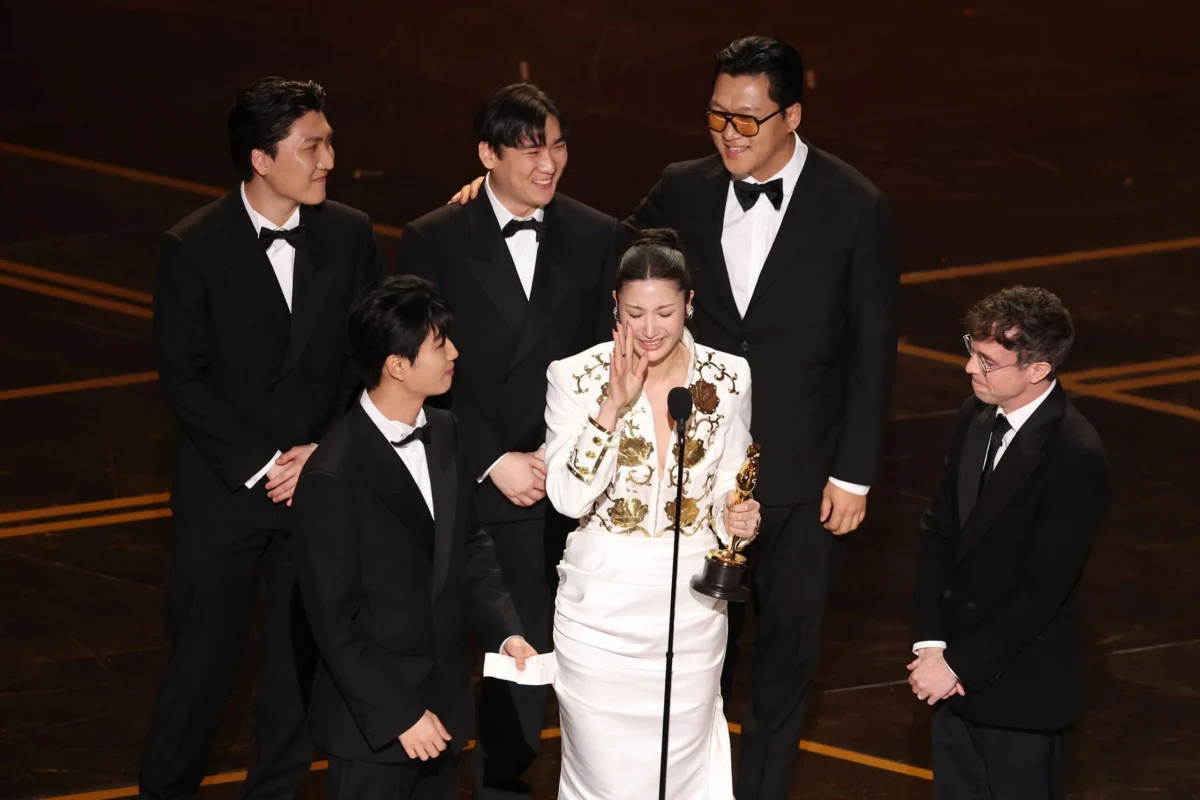
The collective memory of global audiences is often indexed by the melodies that define specific eras. Just as 1998 was inextricably linked to the sweeping romanticism of Celine Dion’s "My Heart Will Go On" from Titanic, and 1992 was dominated by the vocal prowess of Whitney Houston in The Bodyguard, the mid-2020s have found their definitive anthem. The year 2025, a period of significant transition in the entertainment industry, is now synonymous with the meteoric rise of "Golden," the central composition of the Netflix animated feature K-Pop Demon Hunters. On Sunday, March 15, 2026, at the 98th Academy Awards, this track achieved what was once considered improbable: it secured the Oscar for Best Original Song, marking a historic milestone as the first Academy Award victory directly rooted in the creative DNA of the K-pop industry.
The victory of "Golden" at the Dolby Theatre was the culmination of an unprecedented awards season. The song entered the night as the heavy favorite, having already secured a Golden Globe for Best Original Song and a Grammy Award for Best Song Written for Visual Media. Its win at the Oscars was not merely a recognition of musical quality but a testament to a shifting cultural tide where the boundaries between regional genres and global mainstream pop have effectively dissolved. For the Academy of Motion Picture Arts and Sciences, the award represents an acknowledgment of the sophisticated production standards and emotional resonance inherent in modern K-pop, a genre that has evolved far beyond its initial perception as a localized phenomenon.
The Narrative Power of Golden within K-Pop Demon Hunters
To understand the impact of "Golden," one must examine its role within the framework of K-Pop Demon Hunters. Released in June 2025, the Netflix film quickly ascended to become the most-watched animated feature in the platform’s history. The plot centers on Rumi, Mira, and Zoey, members of the fictional yet globally adored K-pop group HUNTR/X. In a narrative twist that blends urban fantasy with idol culture, the trio leads a double life as mystical warriors tasked with protecting humanity from Gwi-Ma, an ancient demon king who sustains himself on human souls.
The song "Golden" serves as the literal and figurative climax of the film. Within the story, the warriors must utilize their voices to activate the "Honmoon," a magical barrier of immense power. The barrier only reaches its full, demon-sealing potential when it turns a brilliant, pure gold—a transformation triggered by the authenticity and emotional honesty of the singers. "Golden" is the catalyst for this event. Far from being a mere background track, the song is an essential narrative device that mirrors the protagonists’ journey toward self-acceptance.
The lyrics, featuring poignant lines such as "I waited so long to break these walls" and "I won’t hide anymore, I’ll shine as I always should," resonate with audiences because they transcend the film’s supernatural plot. They tap into universal themes of overcoming insecurity and shedding the masks required by societal expectations. This emotional depth, combined with a high-stakes cinematic moment, allowed the song to function as an "emotional archive" for viewers, bridging the gap between a high-concept animated adventure and the personal struggles of the audience.
Technical Mastery and the Return to Musical Maximalism
The production of "Golden" represents a strategic collaboration between the stalwarts of the South Korean music industry and Western cinematic experts. The instrumental architecture was crafted by the powerhouse production team at The Black Label—TEDDY, Ido, and 24—who are widely credited with defining the "YG sound" and the global aesthetic of groups like BLACKPINK. They were joined by American producer Ian Eisendrath, whose background in musical theater and film scoring provided the necessary orchestral sweep to elevate a pop track into a cinematic anthem.
In an era where many pop compositions are intentionally truncated or simplified to cater to TikTok’s viral algorithms, "Golden" is a deliberate outlier. It embraces musical maximalism, featuring a complex structure that begins with restrained, introspective verses before building into a soaring, multi-layered chorus. The song’s bridge is particularly notable for its brief, dissonant interlude that suggests a total collapse, only to resolve into a cathartic final chorus. This "rollercoaster" arrangement is a hallmark of classic K-pop, yet it was executed with a level of sonic sophistication that appealed to the Academy’s traditionalist sensibilities.
Industry analysts suggest that "Golden" may signal a turning point for the K-pop industry itself. For several years, critics argued that the genre was losing its unique identity by chasing short-form trends. The success of "Golden" proves that there is still a massive global appetite for high-production, high-concept music that prioritizes emotional storytelling over fifteen-second hooks.
EJAE: The Journey from Rejected Trainee to Oscar Winner
The most compelling human story behind "Golden" is that of Kim Eun-Jae, known professionally as EJAE. As the voice of the character Rumi and one of the song’s primary lyricists and composers, EJAE’s real-life trajectory mirrors the film’s themes of resilience and hidden brilliance. Born in Seoul and raised in New Jersey, EJAE returned to South Korea at age eight, eventually spending a decade as a trainee at SM Entertainment, one of the "Big Three" K-pop agencies.

Despite her talent, EJAE was repeatedly passed over for debut. She was told she was "too tall" or that her voice was "too deep" and "unconventional" for the standard idol mold. After ten years of rigorous training without a debut, she left the agency and fell into a period of deep depression. However, she eventually pivoted to songwriting, a move she describes as a "happy accident" that saved her life. Returning to SM Entertainment not as a trainee, but as a sought-after songwriter, she penned hits for Red Velvet ("Psycho") and Aespa ("Drama"), establishing herself as a formidable force behind the scenes.
Her involvement in K-Pop Demon Hunters began in 2019 when composer Daniel Rojas introduced her to the film’s directors, Maggie Kang and Chris Appelhans. The creation of "Golden" was famously spontaneous; EJAE received the rough instrumental track from The Black Label while she was in a taxi on her way to a dentist appointment. Struck by the "golden" theme requested by the directors, she began writing the melody and lyrics during the commute.
EJAE’s performance of the song at the Oscars was a highlight of the ceremony. Joined by Korean-American artists Audrey Nuna and Rei Ami, she delivered a vocal performance that demonstrated the "impossible" range required by the track. Her acceptance speech was a viral moment in its own right: "This award doesn’t represent success; it represents resilience. It is for everyone who has had a door closed in their face. Rejection is just redirection."
Statistical Dominance and Global Reception
The commercial performance of "Golden" has been nothing short of staggering. As of March 2026, the song has surpassed four billion streams across major platforms, making it the most-listened-to single of 2025. It maintained a dominant presence on the Billboard Hot 100, holding the number-one spot for eight consecutive weeks—a rare feat for a song from an animated soundtrack.
The song’s impact extended beyond digital metrics. It sparked a global cultural phenomenon, with "Golden" challenges and covers appearing in nearly every country. The visual aesthetic of the "Honmoon"—the golden light—became a recurring motif in fashion and digital art throughout late 2025. At the 98th Academy Awards, the sight of Hollywood’s elite waving K-pop "lightsticks" during EJAE’s performance served as a vivid illustration of how thoroughly the song had permeated the global zeitgeist.
Chronology of a Masterpiece
The road to the Academy Awards was a multi-year journey that began long before the film’s release:
- 2019: Initial development of K-Pop Demon Hunters begins. EJAE is recruited to the creative team to ensure cultural authenticity.
- 2021-2023: Production of the animation and the soundtrack occurs. "Golden" is composed in a taxi in Seoul during this period.
- June 2025: K-Pop Demon Hunters premieres on Netflix, breaking viewership records for animated content within 48 hours.
- August 2025: "Golden" hits #1 on the Billboard Hot 100, staying there for eight weeks.
- January 2026: The song wins the Golden Globe for Best Original Song. EJAE’s "rejection is redirection" speech goes viral.
- February 2026: "Golden" wins the Grammy for Best Song Written for Visual Media.
- March 15, 2026: The song wins the Academy Award for Best Original Song, cementing its place in cinematic and musical history.
Broader Implications for the Industry
The success of "Golden" and K-Pop Demon Hunters has profound implications for the future of entertainment. For Netflix, it validates a high-budget, culturally specific approach to animation that can compete with traditional studios like Disney and Sony. For the K-pop industry, it provides a blueprint for how to integrate music into narrative storytelling in a way that feels organic rather than promotional.
Furthermore, the win highlights the increasing influence of the Korean-American diaspora in Hollywood. With a creative team consisting of both Seoul-based producers and Western-based artists, "Golden" is a hybrid product that represents the future of globalized media. It is a song that belongs to no single territory, but rather to a global audience that values authenticity and high-caliber artistry.
As the 98th Academy Awards concluded, it was clear that "Golden" had done more than just win a trophy. It had validated the careers of artists like EJAE, who were once told they didn’t fit the mold, and it had proven that a song from an animated film about demon hunters could carry the same emotional weight as the greatest ballads in cinema history. The legacy of "Golden" is now etched into the archive of the Academy, serving as a permanent reminder that the most powerful barriers are broken not with force, but with the courage to shine.

0 Comments