
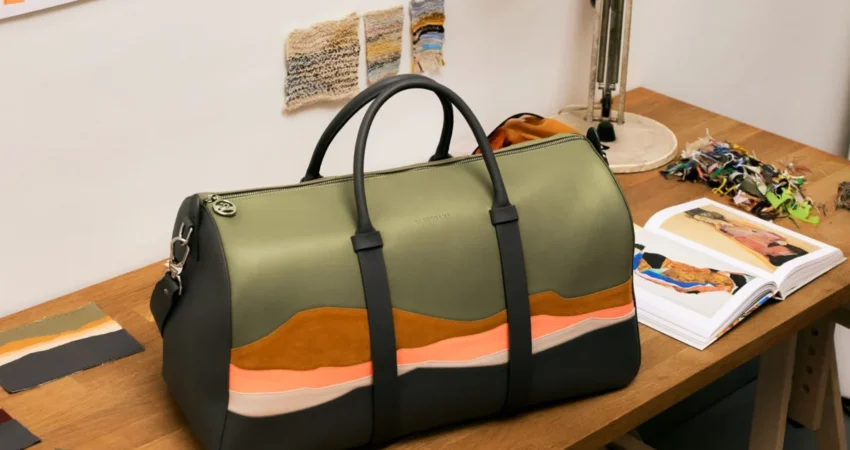
The French luxury house Longchamp has officially unveiled its Fall-Winter 2026 partnership with Brussels-based visual artist Caroline Hélain, a collaboration that marks a significant intersection between high-fashion accessory design and contemporary textile art. This collection represents a departure from traditional seasonal releases by transforming functional everyday objects into "portable works of art," utilizing intricate layers of texture, hand-cut materials, and a sophisticated palette of mineral tones. By integrating Hélain’s abstract landscapes into the Maison’s most iconic silhouettes, Longchamp continues its long-standing tradition of bridging the gap between the atelier and the artist’s studio.
The Artistic Philosophy of Caroline Hélain
Caroline Hélain, a French visual artist whose practice is currently centered in Brussels, has gained international recognition for her unique approach to landscape representation. Unlike traditional landscape painters who rely on pigments and brushes, Hélain utilizes textiles as her primary medium. Her work is characterized by an exploration of the relationship between memory, matter, and the physical environment. By cutting fabrics freehand and employing "free stitching"—a technique where seams remain visible and integrated into the composition—she creates tactile topographies that suggest natural formations.

Hélain’s compositions exist in the liminal space between figuration and abstraction. Her work does not seek to replicate specific geographical locations; instead, it evokes the essence of nature. A single strip of raw-edged silk might suggest a distant horizon, while overlapping layers of wool or linen can conjure the depth of a cliffside or the undulating curves of a sand dune. For the Fall-Winter 2026 collection, Hélain developed nine distinct abstract landscapes specifically for Longchamp, ensuring that the artwork was conceived with the dimensions and movement of the human body in mind.
The Genesis of the Collaboration: A Digital Discovery
The partnership began through a modern creative avenue: social media. Sophie Delafontaine, the Creative Director of Longchamp and granddaughter of the Maison’s founder, discovered Hélain’s work on Instagram. Delafontaine was reportedly drawn to the artist’s sensitivity to color and the precision of her artisanal technique. This discovery occurred during the conceptual phases of the Fall-Winter 2026 collection, which sought to emphasize "creative curiosity" and the "human hand."
The chronology of the collaboration moved from digital appreciation to physical experimentation. Delafontaine and Hélain engaged in a series of dialogues that sought to translate Hélain’s textile-on-textile method into the language of luxury leather goods. This required the Longchamp artisans to adapt their traditional leather-working techniques to mimic the artist’s freehand cutting and layered assembly. The resulting collection is not merely a series of printed items but a physical reconstruction of art through leather appliqué and technical knitwear.

Technical Mastery in the Longchamp Ateliers
A primary challenge of the collaboration was the translation of Hélain’s textile landscapes into leather, particularly for the "Daylong" bag. The Daylong, available in both a mini format and a spacious weekender size, serves as the centerpiece of the capsule. To achieve the depth found in Hélain’s original works, Longchamp’s craftsmen utilized varying thicknesses and textures of leather. These pieces were hand-cut to maintain the "freehand" aesthetic of the artist and then meticulously layered and stitched onto the bag’s surface.
This process ensures that the landscapes are not static images but three-dimensional structures that change appearance based on lighting and the angle of observation. The horizontal bands of leather create a sense of continuous motion, mimicking the way a horizon shifts as a traveler moves across a landscape. This technical achievement highlights Longchamp’s commitment to savoir-faire, demonstrating that even a large-scale luxury brand can maintain the integrity of an artisanal, handcrafted vision.
Reimagining the Le Pliage Legacy
No Longchamp collaboration is complete without a reinterpretation of the Le Pliage, the brand’s most recognizable silhouette since its debut in 1993. In the Caroline Hélain collection, the Le Pliage Collection tote takes on a more graphic and lightweight character. Printed on cotton canvas, the artist’s landscapes are rendered in a mineral-inspired palette featuring shades of Olive, Thistle, Caramel, and Ballet.

The choice of these specific colors reinforces the collection’s connection to the earth and the natural world. While the Daylong bags offer a tactile, sculptural experience, the Le Pliage pieces provide a more accessible, daily-use version of the collaboration. The integration of Hélain’s art into the Le Pliage demonstrates the versatility of her abstract style, proving that it can exist as both a high-relief leather construction and a refined graphic print.
Beyond Accessories: Ready-to-Wear and Silk Art
The Longchamp x Caroline Hélain collection extends its reach into the realm of prêt-à-porter, specifically through technical knitwear. Long dresses and sweaters serve as expansive canvases for Hélain’s landscapes. Because the garments are made of knit, the artwork transforms with the movement of the wearer’s body, creating a dynamic visual experience that mirrors the fluid nature of the landscapes they represent.
Additionally, the collection includes a silk scarf that acts as a "portable gallery." This piece is unique because it features all nine landscapes created by Hélain for the Maison in a single composition. It serves as a comprehensive overview of the collaboration, allowing enthusiasts to appreciate the full spectrum of color, rhythm, and texture that defined the project. The silk scarf underscores the idea that fashion can serve as a medium for artistic storytelling, providing a narrative of nature and memory that can be worn in various forms.

Market Context and the Rise of "Artisanal Luxury"
The collaboration between Longchamp and Caroline Hélain arrives at a time when the luxury market is shifting away from overt logos toward "intellectual luxury" and artisanal storytelling. Industry analysts suggest that consumers are increasingly seeking products that offer a sense of uniqueness and human connection. By partnering with a visual artist who emphasizes hand-cutting and visible stitching, Longchamp aligns itself with the "Quiet Luxury" trend while adding a layer of creative depth that distinguishes it from its competitors.
Longchamp has a historical precedent for such ventures. Since the early 2000s, the Maison has collaborated with a diverse array of creatives, including Tracey Emin, Jeremy Scott, and Thomas Heatherwick. However, the Hélain collaboration is notable for its focus on the process of making rather than just the final aesthetic. It highlights a growing trend where the boundary between the art gallery and the fashion boutique is increasingly blurred, catering to a demographic that values craftsmanship as much as brand heritage.
Broad Implications for Brand Identity
For Longchamp, this collaboration serves to reinforce its identity as a "Maison" that values artistic freedom and technical innovation. By giving Hélain the platform to create nine bespoke works, the brand demonstrates a level of respect for the artist’s vision that goes beyond typical commercial licensing. This approach fosters brand loyalty among "connoisseur" consumers who are looking for investment pieces that carry cultural weight.

Furthermore, the focus on hand-cut leather and durable textiles suggests a subtle move toward sustainability through longevity. Pieces that are marketed as "art" are less likely to be discarded after a single season, aligning with a more conscious approach to consumption. The Fall-Winter 2026 collection suggests that the future of Longchamp lies in its ability to remain a family-run business that can pivot quickly to embrace new digital discoveries while maintaining the rigorous standards of French leather-working.
Conclusion: A Synthesis of Nature and Industry
The Longchamp x Caroline Hélain collection is more than a seasonal update; it is a synthesis of natural inspiration and industrial precision. By taking the everyday objects of a modern lifestyle—the tote bag, the weekender, the knit sweater—and imbuing them with the abstract beauty of Hélain’s textile landscapes, Longchamp invites its audience to "pause their gaze."
As the fashion industry continues to navigate the complexities of a digital-first world, the story of Sophie Delafontaine finding Caroline Hélain on social media serves as a blueprint for modern creative direction. It proves that the most traditional of luxury houses can find new life by looking through the lens of contemporary art, ensuring that the legacy of the "human hand" remains central to the luxury experience. The collection will be available globally, marking a significant milestone in the ongoing dialogue between the world of fine art and the global fashion stage.

0 Comments