
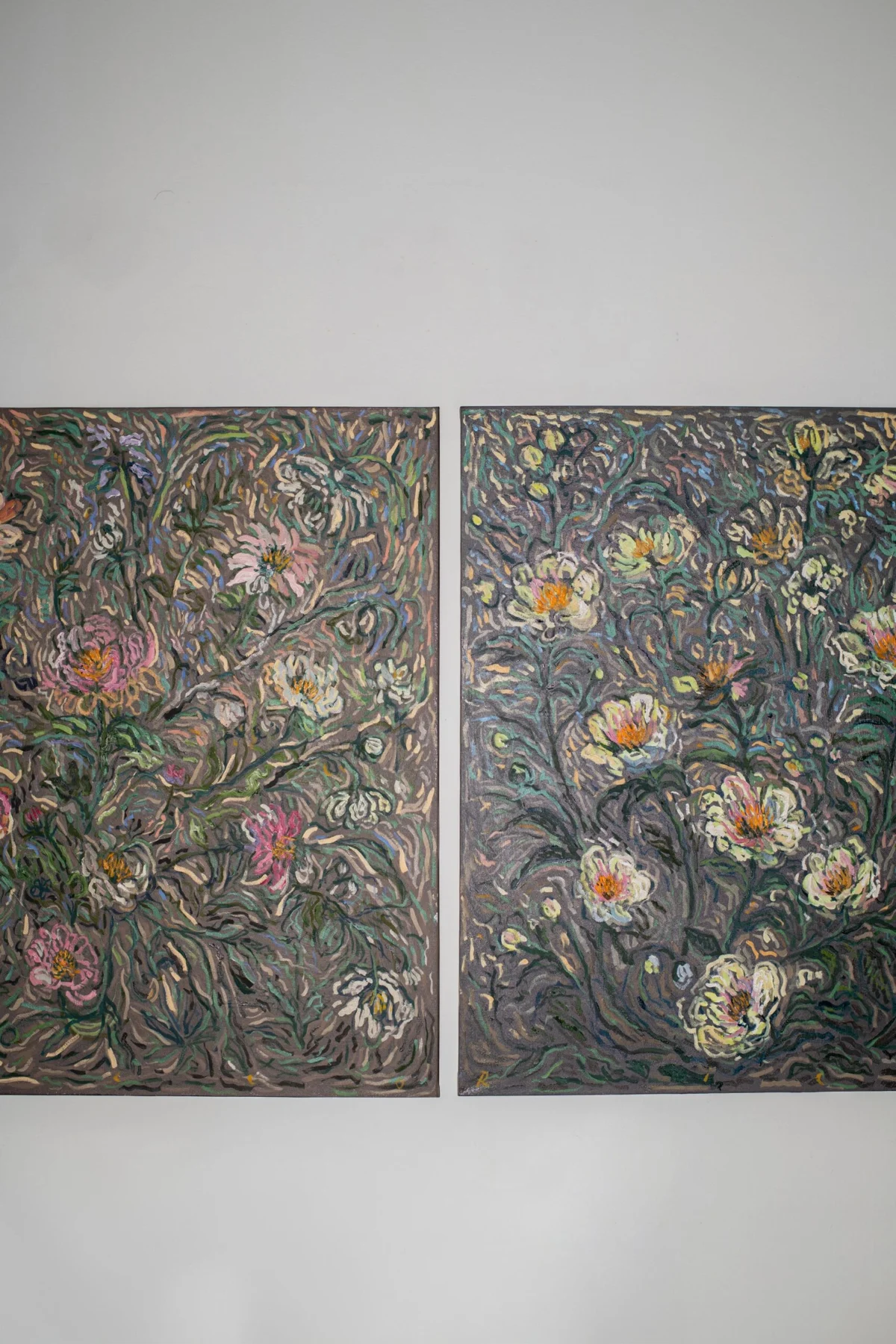
In the dense and often frenetic urban landscape of Mexico City, where the contemporary art scene is frequently defined by visual saturation and high-speed digital consumption, a new collective exhibition is challenging the status quo by demanding a deliberate deceleration. Organized by Racanska Galería, the exhibition "Más flores, más amor" (More Flowers, More Love) serves as a curated intervention designed to foster contemplation and emotional reconnection. By centering the exhibition on the concept of "blooming," the organizers have established a metaphorical framework that explores the intersection of biological cycles, human fragility, and the persistence of life within a modern context.
Curated by Anna Sofia Racansky, the exhibition transcends the merely decorative traditions of floral art. Instead, it positions the flower as a sophisticated semiotic tool—a language capable of articulating complex truths about the human condition. The show, which integrates painting, sculpture, installation, photography, and industrial design, represents a collaborative effort that brings together a diverse array of artists. These creators, ranging from established figures to emerging voices, share a common objective: to look toward the essential and the vital in an era often dominated by the ephemeral and the artificial.

The Philosophical Foundation of the Exhibition
The central premise of "Más flores, más amor" is rooted in the idea that art can serve as a sanctuary. In her curatorial statement, Anna Sofia Racansky emphasizes that flowers are not chosen for their aesthetic passivity but for their symbolic resilience. According to Racansky, the exhibition is a response to the current global and local climate of uncertainty. By focusing on the "act of blooming," the exhibition highlights a natural process that is both inevitable and vulnerable, serving as a mirror for social and personal transformation.
This approach is particularly resonant in Mexico City, a metropolis that has historically maintained a deep, multi-layered relationship with floral iconography. From the pre-Hispanic veneration of Xochipilli, the "Prince of Flowers," to the ubiquitous presence of marigolds in contemporary Day of the Dead rituals, flowers are inextricably linked to the Mexican identity. Racansky’s curation acknowledges this heritage while pivoting toward a contemporary dialogue. The exhibition does not merely replicate traditional motifs; it reactivates them to address modern concerns such as environmental precarity, the need for mental stillness, and the reclamation of "softness" as a form of social resistance.
Chronology and Collaborative Framework
The development of "Más flores, más amor" follows a timeline of increasing institutional collaboration within the Mexican art market. The project was conceived as a "pop-up" exhibition, a format that has gained significant traction in the 2025–2026 art circuit due to its flexibility and ability to activate non-traditional spaces.

- Inception and Curatorial Design (Late 2025): Anna Sofia Racansky began identifying artists whose work intersected with organic themes and emotional intelligence. The goal was to move away from the "confrontational" nature of much contemporary art toward an aesthetic of "tenderness" and "pause."
- Institutional Synergy (Early 2026): A strategic alliance was formed between Racanska Galería and Mono Galería. This partnership was built on shared aesthetic values and a mutual desire to expand the visibility of artists within the CDMX ecosystem. This collaboration reflects a broader trend in the Latin American art market where independent galleries pool resources to compete with larger, blue-chip institutions.
- Launch and Art Week Integration (February 2026): The exhibition was timed to coincide with the heightened international attention surrounding the Material Art Fair (Vol. 12) and Mexico City Art Week. By positioning the show in Colonia Roma—a historic neighborhood that serves as the heart of the city’s gallery district—the organizers ensured a high level of engagement from both local collectors and international curators.
- Current Phase (March – April 2026): The exhibition remains open to the public at Aguascalientes 112, with programming designed to sustain the conversation through the first week of April.
Analysis of Participating Artists and Media
The strength of "Más flores, más amor" lies in its refusal to standardize the floral theme. Rather than seeking a uniform visual style, the exhibition prioritizes conceptual coherence, allowing each artist to maintain a distinct voice. The roster includes a wide spectrum of disciplines:
- Ceramics and Sculpture: Santiago Pani presents "Flores en tu pelo" (Flowers in your hair), a low-temperature ceramic work from 2025 that explores the tactile nature of growth. His work is complemented by the structural designs of Wchaput Studio, which provided the bases and mirrors that ground the organic forms within the gallery space.
- Multimedia and Digital Intersections: Olya Dubatova’s "Between waves of invisible cities VII" (2023) offers a more abstract interpretation of the theme, linking the organic cycles of nature to the invisible rhythms of urban life.
- Illustration and Pop Culture: Taquito Jocoque, an artist known for her vibrant and often humorous take on Mexican identity, contributes unique pieces that bring a sense of playfulness and accessibility to the show.
- Photography and Installation: The exhibition features the photographic work of Daniela Jacobo and Daniela Gamboa, whose lenses capture the fleeting moments of botanical life. Meanwhile, artists like Alejandro Glatt and Dirty Napkin provide installations that challenge the viewer’s perception of space and materiality.
Other notable contributors include Flordelolvido, Miguel Cuauhtémoc, Moisés Zonana, Jordi Alós, Ricardo de la Torre, Ricardo Echeveste, Marsseia, Rolando Calderón, Marco Kalach, and the curator herself, Anna Sofía Racansky. This "constellation of practices," as described by the gallery, ensures that the exhibition remains a dynamic landscape rather than a static display.
Supporting Data: The Socio-Economic Context of the CDMX Art Scene
The timing and format of "Más flores, más amor" are indicative of significant shifts in the regional art economy. According to market data from the 2025 fiscal year, Mexico City has seen a 15% increase in "alternative art spaces" and pop-up galleries. This growth is attributed to the rising costs of permanent real estate in neighborhoods like Roma and Condesa, as well as a shift in collector behavior. Modern collectors are increasingly seeking "experiential" art—exhibitions that offer a specific atmosphere or emotional resonance rather than just a commercial transaction.

Furthermore, the integration of "design" and "art" seen in this exhibition—specifically the inclusion of Wchaput Studio—mirrors a global trend where the boundaries between functional design and fine art are becoming increasingly porous. In the 2026 market, "collectible design" has become a major sector, with a reported 22% growth in sales within the Latin American region over the past two years.
Official Responses and Curatorial Philosophy
The reaction from the local artistic community has been largely positive, with many praising the exhibition’s "radical softness." In an era where contemporary art often feels obligated to be loud, political, or technologically complex, "Más flores, más amor" suggests that there is a different kind of power in silence and simplicity.
Anna Sofia Racansky has been vocal about the "politics of tenderness." In a recent statement regarding the exhibition’s impact, she noted: "In a world that demands constant productivity and immediate reaction, the act of stopping to look at a flower is a subversive gesture. We are not evading reality; we are grounding ourselves in the most fundamental reality of all: that life persists, and that blooming is a natural, unstoppable act."

Representatives from Mono Galería echoed this sentiment, stating that the collaboration was born out of a necessity to create "networks of visibility." By joining forces, the two galleries have been able to provide a platform for seventeen different artists, creating a synergy that would have been difficult to achieve in isolation.
Broader Impact and Implications
The exhibition "Más flores, más amor" serves as a case study for the future of curated collective shows in high-density urban environments. It demonstrates that thematic exhibitions can avoid the pitfalls of cliché by anchoring themselves in deep-seated cultural symbolism and high-quality craftsmanship.
The broader implications for the Mexico City art scene are twofold:

- The Validation of "Slow Art": The success of this show suggests a growing appetite for "slow art" movements. As digital fatigue continues to affect audiences, spaces that prioritize physical presence and contemplative pacing are likely to become more valuable.
- The Strengthening of Independent Networks: The partnership between Racanska and Mono Galería provides a blueprint for how independent entities can collaborate to create high-impact cultural events without the backing of major corporate sponsors. This decentralized approach fosters a more resilient and diverse artistic ecosystem.
As the exhibition enters its final weeks, it stands as a reminder that the most profound messages are often found in the most delicate forms. The "landscape of emotions" curated by Racansky offers a rare opportunity for the public to engage with the essential rhythms of life, encouraging a shift from mere observation to genuine feeling.
Visitor Information and Final Schedule
"Más flores, más amor" will continue to be on display through the first week of April 2026. The exhibition is hosted at the following location:
- Address: Aguascalientes 112, Colonia Roma, Mexico City.
- Closing Date: Early April 2026.
- Admission: Open to the general public, following the gallery’s standard operating hours.
The exhibition concludes a significant chapter in the 2026 spring art season, leaving behind a dialogue on how art can serve as both a refuge and a reminder of the persistent, natural cycles that define our existence. In the heart of one of the world’s most chaotic cities, "Más flores, más amor" has successfully carved out a space where the simple act of blooming is recognized as a profound form of resistance.

0 Comments