
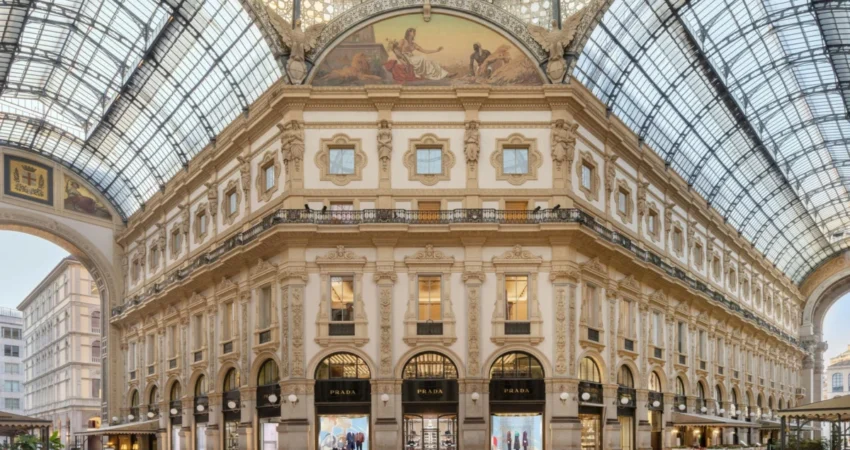
The Prada Group has officially unveiled its most ambitious retail and cultural project to date, a sprawling eight-story complex located within the historic heart of Milan. Known as Prada Galleria, the site represents a significant expansion of the brand’s original flagship in the Galleria Vittorio Emanuele II, the prestigious shopping arcade where the company first opened its doors in 1913. This development marks a pivotal shift in the brand’s strategy, blending commercial retail with gastronomy, fine art, and a permanent archival exhibition, effectively transforming a single boutique into a multi-dimensional landmark dedicated to the heritage and future of the Prada name.
The project is a paradoxical blend of the old and the new. While the ground-floor storefront remains a testament to the brand’s founding by brothers Mario and Martino Prada over a century ago, the upper levels and subterranean passages have been redesigned to house a comprehensive ecosystem of luxury. The expansion integrates several previously disparate elements, including the historic Marchesi 1824 pastry shop, the Osservatorio Fondazione Prada, and the newly established Pradasphere exhibition space. By unifying these assets, Prada is asserting its role not just as a fashion house, but as a cultural institution deeply rooted in the civic life of Milan.
A Century of Evolution: From Fratelli Prada to a Global Powerhouse
To understand the significance of the Prada Galleria, one must look back to 1913, when the brand was known as Fratelli Prada (Prada Brothers). Originally specializing in English steamer trunks, fine leather goods, and luxury travel accessories, the shop quickly became a destination for the Italian aristocracy. In 1919, the brand was appointed as an official supplier to the Italian Royal House, allowing it to incorporate the coat of arms of the House of Savoy into its logo—a symbol that remains part of the brand’s identity today.
.jpg)
The modern era of the company began in the late 1970s when Miuccia Prada, Mario’s granddaughter, took the helm alongside her husband and business partner, Patrizio Bertelli. Together, they transitioned the brand from a local leather goods purveyor into a global vanguard of avant-garde fashion. This growth is reflected in the Group’s most recent financial performance; in 2023, the Prada Group reported annual revenues of €5.7 billion, supported by a network of 423 directly operated boutiques worldwide. Despite this global reach, the Prada Galleria project signals a strategic return to the brand’s geographic and emotional center.
Architectural Integration and the Passaggio Segreto
The architectural strategy of Prada Galleria focuses on connectivity. For decades, the brand operated separate boutiques for its men’s and women’s collections within the Galleria. The new complex fuses these spaces through an innovative subterranean tunnel named the "Passaggio Segreto" (Secret Passage). This corridor does not merely serve as a functional link; it functions as a curated gallery of "hidden treasures," displaying rare objects from the Prada archives that reveal the brand’s creative evolution.
Above ground, the complex rises through the levels of the historic building. The ground floor maintains the original 1913 aesthetic, featuring the curved mahogany display cases and marble floors that defined the brand’s early years. As visitors ascend, the environment shifts. The first floor, or piano nobile, is now home to Pradasphere, the first permanent exhibition dedicated to the maison’s history. The higher levels house the Osservatorio Fondazione Prada, an art space opened in 2016 that focuses on photography and visual languages, located just beneath the arcade’s iconic glass-and-iron dome.
Pradasphere: A Permanent Record of Continuity
The Pradasphere exhibition is designed to bridge the gap between the brand’s bourgeois origins and its later reputation for intellectual minimalism. The narrative is not strictly chronological but is instead organized around themes of "continuity in discontinuity." It showcases everything from 1920s metal-clad brushes and bespoke vanity cases to the nylon backpacks that revolutionized the luxury market in the 1980s.
.jpg)
Key highlights of the exhibition include:
- The 1988 Debut: The first look from Miuccia Prada’s inaugural Fall/Winter 1988 runway show—a sculptural black coat and trouser set—is displayed as a foundational moment of the brand’s modern aesthetic.
- Collaborations and Cinema: Items such as the crystal-encrusted dresses designed for The Great Gatsby and the 2008 James Jean "Fairy" collection highlight the brand’s long-standing intersection with film and graphic art.
- Technological Forays: The display includes the LG Prada touch-screen smartphones from 2008, reminding visitors that Prada was a pioneer in luxury technology years before the smartphone market became saturated.
- Future Frontiers: The exhibit culminates with the Prada-designed space suit for NASA’s Artemis III and IV lunar missions, scheduled for later this decade, symbolizing the brand’s commitment to technical innovation.
Strategic Heritage Branding in a Modern Market
The decision to emphasize heritage comes at a time when the luxury sector is increasingly focusing on "storytelling" to differentiate itself in a volatile global economy. Lorenzo Bertelli, the Group’s Head of Corporate Social Responsibility and Marketing Director—and the great-grandson of Mario Prada—notes that the brand has matured to a point where it can finally embrace its past without fear of appearing stagnant.
In discussions regarding the project, Bertelli emphasized that while the brand was synonymous with "minimalism" and "newness" in the 1990s, the contemporary consumer is looking for depth and authenticity. By opening the family archives and the "Appartamento"—a private hospitality suite on the third floor designed with the personal aesthetic of Miuccia Prada and Patrizio Bertelli—the brand is inviting its top-tier clients into a more intimate relationship with the Prada family history.
The "Appartamento" itself is a study in the "Prada-esque" aesthetic: a mix of 18th-century gilded mirrors, mid-century velvet armchairs, and contemporary photography by Andreas Gursky. This space is not for general retail but is reserved for private events and the brand’s most loyal customers, reflecting a broader trend in luxury retail toward exclusive, residential-style experiences.
.jpg)
Gastronomy and the "Salotto di Milano"
A key component of the Prada Galleria complex is its integration of Marchesi 1824. The Prada Group acquired the historic Milanese pastry shop in 2014, and its location within the Galleria has become a central hub for both tourists and locals. In the context of the new complex, Marchesi acts as the social anchor, reinforcing the Galleria’s historical reputation as the "Salotto di Milano" (Milan’s Drawing Room).
The inclusion of gastronomy within a fashion complex follows a successful model seen in other luxury flagship developments, where food and beverage services increase "dwell time" and create a lifestyle destination rather than a mere point of sale. For Prada, Marchesi represents the "bourgeois" side of Milanese life that Miuccia Prada has often both celebrated and subverted in her designs.
Analysis of Implications for the Luxury Industry
The launch of Prada Galleria is more than a store opening; it is a statement of resilience and long-term vision. By investing heavily in a permanent physical landmark in its home city, Prada is countering the digital-first narrative that dominated the retail industry during the pandemic years.
Industry analysts suggest that such "mega-flagships" serve several purposes:
.jpg)
- Brand Equity: They solidify the brand’s narrative, making it harder for competitors to replicate the "aura" of a century-old house.
- Vertical Integration: By housing art, food, and fashion under one roof, the brand controls every touchpoint of the consumer experience.
- Real Estate Dominance: Securing and expanding presence in the Galleria Vittorio Emanuele II—one of the world’s most expensive and prestigious retail locations—is a defensive move that ensures the brand remains at the center of the global fashion conversation.
Furthermore, the project reflects a shift in how luxury brands handle their archives. Rather than keeping history in a warehouse, brands like Prada are turning their past into a "living" asset that can be monetized through prestige and customer loyalty.
Conclusion: A Visionary Look Backward
As the Prada Galleria opens its doors to the public, it offers a rare look into the internal logic of one of fashion’s most private families. From the "Passaggio Segreto" to the NASA space suits, the complex suggests that for Prada, the future is inextricably linked to the past.
The project arrives at a symbolic moment for Milan, as the city prepares to host Vogue World in 2026 within the same Galleria. By expanding its footprint so significantly, Prada is not just preparing for the next fiscal year, but for the next century of its history. As the quote from Robert Musil found in the "Appartamento" suggests, Prada continues to operate in a world that is "mobile, singular, visionary, and irrational," maintaining its status as a brand that thrives on the very contradictions it creates.

0 Comments