
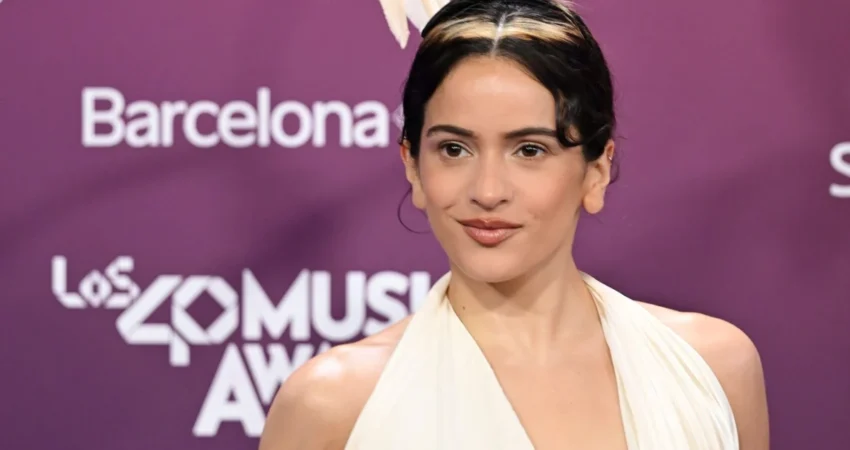
The presence of Spanish singer Rosalía at the LOS40 Music Awards in Barcelona on Friday night marked a significant moment in the intersection of contemporary music and avant-garde haute couture. Arriving at the Palau Sant Jordi, the artist garnered immediate international attention by wearing an architectural headpiece featuring a large white dove in mid-flight, a creation from designer Robert Wun’s Autumn/Winter 2026 Haute Couture collection. The sculptural accessory, characterized by its dramatically extended wingspan, was paired with a custom ivory silk gown by Maison Margiela, featuring a deep halter neckline and delicate plissé detailing. This appearance underscores a growing trend in high-profile red carpet events where traditional glamour is being superseded by theatrical, conceptual art pieces that challenge the boundaries of wearable fashion.
The Architectural Composition of the Look
The ensemble presented by Rosalía was a calculated exercise in contrast and thematic cohesion. The Maison Margiela gown, designed under the creative direction of John Galliano, offered a minimalist foundation that allowed the headpiece to serve as the primary focal point. The dress’s ivory hue and fluid draping provided a classical silhouette, reminiscent of Grecian statuary, which served to ground the more eccentric elements of the styling.
The headpiece itself is a product of the "Child’s Play" collection by Robert Wun, a London-based designer of Hong Kong origin who has rapidly become a fixture in the haute couture circuit. Created in collaboration with renowned milliner Awon Golding, the dove accessory is more than a decorative hat; it is a hand-sculpted piece of art designed to simulate the kinetic energy of a bird taking flight. By pulling her dark hair back into a sleek bun and utilizing a bleached "halo" effect around her hairline, Rosalía’s styling team ensured that the avian structure had the necessary visual space to dominate the silhouette without distraction.
Chronology of Rosalía’s Artistic and Sartorial Evolution
To understand the significance of this fashion choice, it is essential to view it within the timeline of Rosalía’s career and her evolving visual identity. Since the release of her breakthrough album El Mal Querer in 2018, the singer has consistently integrated traditional Spanish iconography with hyper-modern aesthetics.

- The Flamenco-Futurism Era (2018–2020): During this period, Rosalía utilized ruffled silhouettes, long acrylic nails, and streetwear-inspired high fashion to redefine the visual language of flamenco for a global audience.
- The Motomami Phase (2022–2024): This era saw a shift toward leather, helmet-inspired headwear, and a "biker-chic" aesthetic that emphasized speed, strength, and industrial textures.
- The Religious and Celestial Transition (2025–Present): Her most recent public appearances and her "Lux" tour have been characterized by what critics call "otherworldly" or "divine" fashion. This includes the Margiela-designed nun-inspired headpiece featured on recent promotional material and the theatrical, halo-like hats worn during her live performances.
The choice of a dove—a symbol traditionally associated with peace, the Holy Spirit, and divine intervention—aligns perfectly with this current stage of her artistic journey. It reflects a sophisticated maturation of her "religious imagery" motif, moving from the literal to the surreal.
Robert Wun and the New Era of Red Carpet Theatricality
The appearance of the dove headpiece in Barcelona is part of a broader surge in the popularity of Robert Wun’s work among A-list celebrities. Wun, who became the first Hong Kong designer to be invited by the Fédération de la Haute Couture et de la Mode to show on the official Paris Haute Couture schedule, has built a reputation for designs that blur the line between costume and sculpture.
Just days prior to the LOS40 Music Awards, actress Whitney Peak appeared at the New York premiere of The Hunger Games: Sunrise on the Reaping wearing a cobalt blue gown from the same Wun collection. Her outfit featured two white birds that appeared to be lifting the fabric of the dress into the air. Similarly, Elle Fanning recently adopted a surrealist aesthetic inspired by the character Effie Trinket, wearing a pink Robert Wun couture gown topped with a pillbox hat featuring a miniature ballerina.
These instances suggest a shift in celebrity styling strategies. In an era where social media engagement is a key metric of a red carpet appearance’s success, "viral fashion"—pieces that are instantly recognizable and conceptually bold—has become a priority for both designers and performers.
Comparative Analysis of Contemporary Millinery Trends
Rosalía is not alone in her embrace of avant-garde headwear. A survey of recent major fashion events reveals that the "statement hat" is experiencing a significant renaissance, moving away from the minimalist trends of the early 2020s.

- Dua Lipa: The pop star recently championed artistic millinery with a Chanel Haute Couture fringe hat, which obscured and revealed her face through movement.
- Anya Taylor-Joy: At a recent film festival, Taylor-Joy wore a massive, circular Jacquemus hat that framed her head like a structural halo, echoing the celestial themes seen in Rosalía’s wardrobe.
- Hunter Schafer and Taylor Russell: Both actresses have experimented with tactile, fur-based headwear from Undercover and collaborations with independent artisans like Ilana Blumberg, signaling a move toward eccentric textures in winter fashion.
The "Child’s Play" collection by Wun specifically explores the themes of childhood wonder and fairy tales. By bringing these themes to the red carpet, artists like Rosalía are participating in a narrative-driven form of fashion that prioritizes storytelling over mere ornamentation.
The Significance of LOS40 Music Awards in the Industry
The LOS40 Music Awards, organized by Spain’s largest music radio station, LOS40, serve as a critical barometer for the Spanish-speaking music market. Held annually, the event honors both domestic and international talent, making it a high-stakes environment for fashion statements.
For Rosalía, returning to her home region of Catalonia for this event added a layer of cultural resonance to her appearance. The choice of a dove—a universal symbol of peace—at a time of significant global and regional discourse was interpreted by many industry observers as a subtle but powerful message. While the singer did not issue a formal political statement, the visual cues of her outfit spoke to a desire for serenity and higher artistic purpose.
The awards ceremony itself featured performances and appearances by a wide array of international stars, but Rosalía’s entrance remained the most discussed moment of the evening. Data from social media monitoring tools indicated that "Rosalía" and "Robert Wun" were trending topics in both Spain and the United States within hours of her arrival.
Technical and Symbolic Implications
From a technical perspective, the Dove headpiece represents a triumph of modern millinery. The balance required to keep such a large, asymmetrical piece stable while the wearer moves through a crowded red carpet requires precise engineering. The use of lightweight polymers and traditional wire-framing allows for the "frozen in time" effect of the wings.

Symbolically, the dove connects Rosalía to a long history of surrealism in Spanish art. From Salvador Dalí’s use of organic forms to Elsa Schiaparelli’s (an Italian designer with deep ties to the surrealist movement) bird-themed accessories in the 1930s, the "bird as fashion" motif has deep roots in the European avant-garde. By reviving this aesthetic, Rosalía positions herself as a successor to these cultural provocateurs, using her body as a canvas for high-concept art.
Future Impact on Fashion and Celebrity Branding
The reception of Rosalía’s look suggests that the fashion industry is entering a period of "maximalist surrealism." As audiences become fatigued by the "quiet luxury" and "clean girl" aesthetics that dominated 2023 and 2024, there is a clear appetite for drama, humor, and technical spectacle.
For Robert Wun, the endorsement by a global superstar like Rosalía solidifies his position as a leading voice in contemporary couture. For the music industry, it raises the bar for red carpet appearances, suggesting that a successful "look" now requires a level of conceptual depth previously reserved for museum exhibitions.
In conclusion, Rosalía’s appearance at the LOS40 Music Awards was not merely a fashion choice but a strategic artistic statement. By blending the heritage of Maison Margiela with the innovative sculpture of Robert Wun, she has reinforced her status as a global style icon who is unafraid to utilize the red carpet as a platform for complex visual storytelling. As the awards season continues, the influence of this "divine" and "dramatic" aesthetic is expected to reverberate across the global fashion landscape, encouraging more stars to embrace the theatrical and the extraordinary.

0 Comments