
The traditional boundaries of seasonal perfumery are undergoing a significant transformation as contemporary noses challenge the long-standing dichotomy between summer and autumn scents. Historically, the transition from the warmth of August to the cooling temperatures of September and October signaled a rigid shift in olfactory preferences: the light, ephemeral notes of citrus and berries were retired in favor of the dense, heavy architectures of patchouli, leather, oud, and spices. However, a new movement in the luxury fragrance sector is dismantling this convention, proving that fruity notes—when anchored by sophisticated base structures—can provide a luminous, complex, and enduring presence throughout the autumn months.

By integrating fruits such as cherry, fig, plum, and pear with resinous ambers, smoky woods, and gourmand elements like vanilla and coffee, perfumers are creating a "third way" for the season. These compositions offer the vibrancy and optimism of summer fruits but possess the "sillage" and longevity required to withstand the crisp air of autumn. This shift reflects a broader trend in the global fragrance market, which is increasingly prioritizing trans-seasonal versatility and personal expression over rigid seasonal rules.
The Market Shift: Data and Consumer Trends
The global fragrance market, valued at approximately $59.2 billion in 2023 and projected to grow at a compound annual growth rate (CAGR) of 5.5% through 2030, is witnessing a surge in the "niche" and "prestige" categories. Within these segments, consumer behavior indicates a growing fatigue with traditional seasonal marketing. Data from industry analysts suggests that younger demographics, particularly Millennials and Gen Z, view fragrance as an extension of mood rather than a response to the weather.

Market research indicates that "fruity-floral" remains the most popular fragrance family globally, yet its association with "youthfulness" and "summer" is being re-engineered. By adding "Noir" or "Intense" iterations to fruity profiles, brands are successfully capturing the autumn market. This evolution is supported by advancements in fragrance chemistry, specifically the development of synthetic molecules that mimic the scent of fruits while providing the molecular weight necessary for slow evaporation, a technical requirement for cold-weather performance.
A Chronology of Seasonal Olfactory Preferences
To understand the current trend, one must examine the historical evolution of autumnal scents. In the early 20th century, the "Chypre" and "Oriental" families dominated the cooler months, characterized by oakmoss, bergamot, and labdanum. By the 1980s, the industry moved toward "powerhouse" scents—heavy, spicy compositions designed for maximum projection.

The 1990s introduced the "Gourmand" era, pioneered by scents like Thierry Mugler’s Angel, which utilized ethyl maltol to create a sugary, autumnal depth. The 2010s saw the rise of "Oud" as a staple for winter and fall. The current decade, however, is defined by the "Fruity-Woody Hybrid." This contemporary era focuses on "texture"—using fruit not for sweetness, but for its tartness, creaminess, or "liquorous" qualities, creating a bridge between the freshness of summer and the comfort of winter.
Leading Fragrances Redefining the Autumnal Palette
The following compositions represent the vanguard of this movement, demonstrating how diverse fruit profiles can be adapted for the cooler months through expert blending.

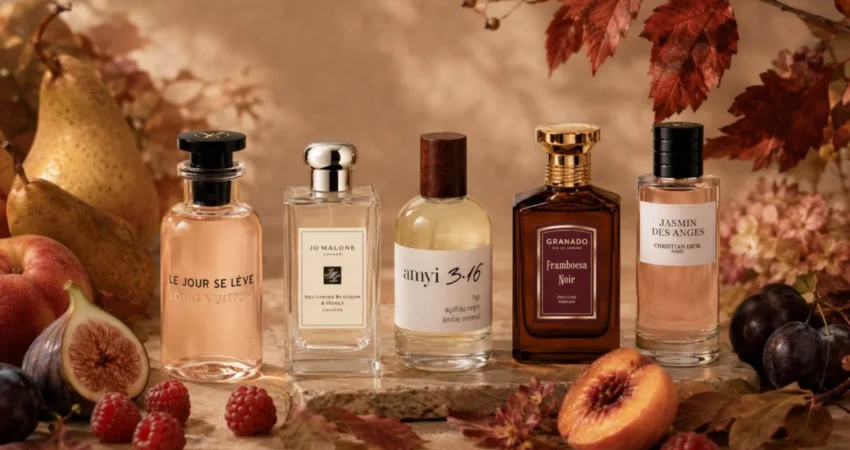
Framboesa Noir by Granado
Granado, a historic Brazilian pharmacy-turned-luxury-perfumer founded in 1870, offers a masterclass in autumnal fruit with Framboesa Noir. While raspberry is often associated with sugary confections, here it is treated with a "noir" sensibility. The fragrance opens with a sharp, sophisticated brightness from green apple and jasmine but quickly descends into a dark, boozy heart. The inclusion of rum, leather, and labdanum provides a velvet-like texture that clings to the skin, transforming the fruit into something reminiscent of a high-end liqueur.
Power of You Eau de Parfum by Giorgio Armani
Armani’s Power of You challenges the notion that tropical fruits like passion fruit belong exclusively to the beach. This composition utilizes a vibrant passion fruit top note but grounds it in a sophisticated floral heart of frangipani. The transition to a base of Madagascar vanilla and benzoin creates a creamy, "gourmand-lite" finish. The result is a luminous fragrance that provides a psychological lift during the shorter days of autumn without losing its structural integrity in lower temperatures.

Ilía Jardim Secreto by Natura
Inspiration for this scent comes from the specific atmosphere of a garden at twilight. Natura utilizes a "purple fruit" accord combined with juicy pear. The autumnal transition is achieved through a robust base of tonka bean, amber, and a surprising hint of coffee. The bitterness of the coffee and the warmth of the amber neutralize the potential sweetness of the pear, resulting in a sophisticated, comforting scent profile.
Chance Eau Tendre Eau de Parfum by Chanel
Under the direction of Olivier Polge, Chanel’s Chance Eau Tendre has become a staple for those seeking "luminous elegance." By utilizing quince and grapefruit, the fragrance maintains a crisp, tart opening. However, the Eau de Parfum concentration relies on a dense core of jasmine and rose, stabilized by high-quality white musks. This provides a "clean" but substantial presence that acts as a perfect accompaniment to autumnal knitwear.

Floratta Rose Sucrée by O Boticário
Drawing inspiration from the crystallized petals of Parisian patisseries, this fragrance pairs litchi and raspberry with Damascus rose. The autumnal depth is provided by "lactonic" notes—milky, creamy accords—and cashmeran. Cashmeran is a vital synthetic component in autumnal perfumery, providing a woody, musky texture that mimics the feeling of cashmere wool against the skin.
Amyi 3.16 by Amyi
Amyi 3.16 represents the artisanal approach to the fruity-autumn trend. It focuses on the fig, but avoids the coconut-heavy sweetness often found in summer fig scents. Instead, it utilizes sea salt and a "buttery" iris to create a mineral, earthy profile. The base of black saffron and mineral amber provides an edgy, sophisticated depth that feels architectural and modern.

Jasmin des Anges by La Collection Privée Christian Dior
Dior’s prestige line explores the late-harvest jasmine of Grasse. In this composition, the apricot note is not merely a garnish but a central pillar. The apricot is rendered with a honeyed, velvety texture that feels "sun-drenched" yet substantial. It is a sophisticated interpretation of "decaying summer," capturing the golden light of October in a bottle.
Magnetic Amber Eau de Parfum Intense by Felisa
Felisa demonstrates the boldest use of fruit with a prominent pineapple note. In Magnetic Amber, the pineapple is stripped of its "piña colada" associations through the addition of bergamot and juniper. The heart is aromatic—featuring sage and geranium—while the base is a classic autumnal powerhouse of amber, vanilla, and musk. This creates a "shared" or unisex appeal that balances high-energy fruit with deep-seated warmth.

Le Jour Se Lève by Louis Vuitton
Master perfumer Jacques Cavallier-Belletrud utilizes mandarin in Le Jour Se Lève to capture the first light of day. While citrus is highly volatile, Louis Vuitton anchors this mandarin with cassis (blackcurrant bud) and a sophisticated musk complex. The cassis adds a green, slightly tart depth that prevents the citrus from feeling too "thin" for the autumn air.
Nectarine Blossom & Honey by Jo Malone London
A perennial favorite that excels in transitional weather, this scent uses the succulence of nectarine, peach, and plum. The "honey" accord acts as a preservative for the fruit notes, providing a sticky, warm coating that makes the fragrance feel cozy. It is often cited by fragrance consultants as a primary example of "scent layering," frequently paired with woodier colognes to enhance its autumnal suitability.

Technical Analysis: Why Fruity-Autumn Works
The success of these fragrances lies in the "volatility curve." In summer, high temperatures cause fragrance molecules to evaporate quickly, which is why light citruses feel refreshing. In autumn, the cold "traps" the scent closer to the skin. To make a fruity scent work in October, perfumers must use "fixatives."
Fixatives like amber, musk, and resins have high molecular weights. When a fruit note is chemically bonded or physically layered with these fixatives, its evaporation is slowed. Furthermore, the psychological impact of "brightness" in the darker months cannot be overstated. As Seasonal Affective Disorder (SAD) affects a portion of the population in the Northern Hemisphere, "olfactory therapy" via luminous fruity notes provides a functional benefit to the wearer, offering a sense of vitality during the transition to winter.

Industry Implications and Future Outlook
The rise of the fruity-autumn fragrance is more than a passing trend; it is an indicator of the "premiumization" of the industry. Brands are no longer selling scents based on simple categories but are instead marketing "olfactory experiences" that challenge the consumer’s palate.
Official statements from major fragrance houses suggest a continued investment in "sustainable synthetics" that can replicate rare fruit extracts while offering enhanced performance. As the industry moves toward more environmentally conscious production, the ability to create complex, multi-seasonal fruity notes in a laboratory setting will reduce the pressure on natural harvests affected by climate change.

In conclusion, the modern autumnal fragrance wardrobe is no longer a dark, heavy monolithic space. It has been revitalized by the inclusion of the fruit kingdom, offering a sophisticated balance of light and shadow. For the consumer, this means a wider range of expression—a chance to carry the vibrancy of the harvest into the cooling embrace of the year’s end. The "fruity-autumn" genre has successfully proven that depth does not always require darkness, and intensity does not always require spice.

0 Comments