
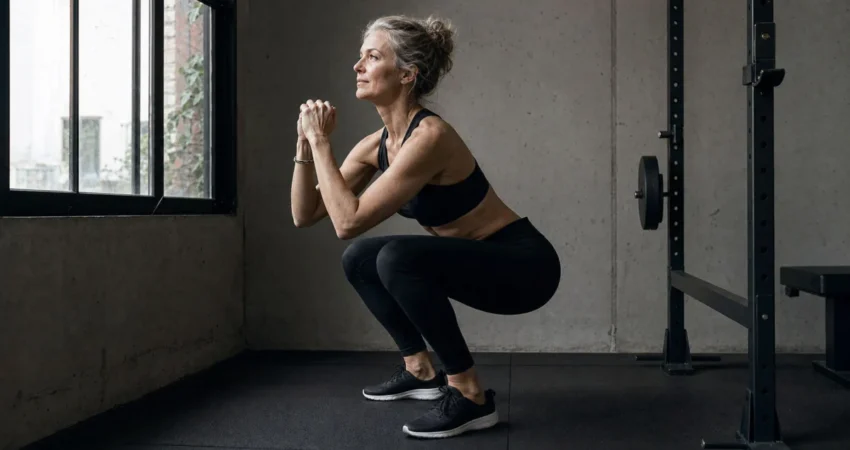
The act of rising from a seated position, a movement performed dozens of times daily without conscious thought, has emerged as a cornerstone of modern geriatric and rehabilitative medicine. Often overlooked in favor of complex gym routines, the "sit-to-stand" movement—essentially a modified squat—is now being recognized by health experts and researchers as one of the most accessible and effective ways to combat the physiological decline associated with aging. By transforming a mundane daily habit into a deliberate strength-training exercise, individuals can target the quadriceps, glutes, and core muscles, fostering the functional independence necessary to maintain a high quality of life. This shift toward functional fitness emphasizes that the most valuable exercises are those that mimic the demands of real-world activity, such as exiting a vehicle, rising from a dining chair, or standing up from a sofa.
The Biomechanics and Clinical Significance of the Chair Squat
At its core, the chair squat is a closed-kinetic-chain exercise, meaning the feet remain in a fixed position on the floor while the body moves. This type of movement is highly effective for building joint stability and muscular endurance. The primary movers are the quadriceps femoris, which extend the knee, and the gluteus maximus, which extends the hip. Secondary support comes from the hamstrings and the erector spinae muscles of the lower back, which work to stabilize the torso during the transition from a seated to a standing posture.
The medical community has long utilized the "Sit-to-Stand" (STS) test as a diagnostic marker for physical frailty. The 30-Second Chair Stand Test, developed by the Centers for Disease Control and Prevention (CDC) as part of the STEADI (Stopping Elderly Accidents, Deaths & Injuries) initiative, measures lower body strength and endurance. A low score on this test is a statistically significant predictor of future falls and hospitalizations. By moving this movement from the diagnostic clinic into the home as a daily exercise, public health advocates hope to preemptively address the muscle loss that leads to disability.

A Chronology of Research: From Diagnostic Tool to Preventative Exercise
The evolution of the chair squat as a recommended exercise follows a timeline of shifting priorities in public health research. In the late 20th century, fitness trends focused heavily on cardiovascular health, emphasizing aerobic activities like jogging or cycling. However, the early 2000s saw a surge in research regarding sarcopenia—the age-related loss of skeletal muscle mass and strength.
In 2010, several landmark studies highlighted that muscle strength, particularly in the lower extremities, was a more accurate predictor of longevity than aerobic capacity alone. By 2018, the World Health Organization (WHO) and the U.S. Department of Health and Human Services updated their physical activity guidelines to place a stronger emphasis on multicomponent physical activity, which includes functional strength and balance training at least two days a week for older adults.
The most recent data, published in journals such as the British Journal of Sports Medicine, indicates that even short bouts of resistance training, such as sets of chair squats, can improve insulin sensitivity and bone density. This has led to the current "functional revolution," where simple movements are being prescribed with the same rigor as pharmaceutical interventions.
Statistical Context: The Rising Need for Accessible Strength Training
The demand for accessible strength training is underscored by global demographic shifts. According to the United Nations, by 2050, one in six people in the world will be over the age of 65. In regions like Europe and North America, this ratio is expected to be one in four. With an aging population comes an increased risk of falls, which are the leading cause of injury-related deaths among adults aged 65 and older.

Supporting data reveals that muscle mass declines at a rate of approximately 3% to 8% per decade after the age of 30, with this rate accelerating significantly after age 60. This loss of tissue directly impacts the ability to perform activities of daily living (ADLs). Clinical trials have shown that consistent lower-body resistance training can reduce the risk of falls by as much as 30%. Furthermore, the economic impact is substantial; the CDC reports that the annual medical costs for fall-related injuries in the United States exceed $50 billion. By promoting zero-cost, home-based exercises like the chair squat, health systems can potentially mitigate these rising costs.
Implementation Guidelines and Safety Protocols
To maximize the benefits of the chair squat while minimizing risk, a structured approach is required. Health professionals recommend the following technical progression:
- Environmental Setup: The exercise must be performed using a sturdy, armless chair (unless the arms are needed for initial support). The chair should be placed against a wall to prevent sliding.
- Postural Alignment: The individual should sit toward the front of the seat with feet hip-width apart and flat on the floor. The knees should be aligned over the ankles.
- The Ascent: By leaning the torso slightly forward (a movement often called "nose over toes") and engaging the core, the individual pushes through the heels to stand upright.
- The Descent: The reverse movement should be controlled and slow, rather than a "collapse" back into the seat. This eccentric phase of the movement is critical for building muscle fibers.
The CDC suggests a target range of 8 to 12 repetitions per set. For beginners, using the hands for assistance is encouraged as a safety measure. As strength improves, the "no-hands" approach is the primary goal. Advanced practitioners can increase difficulty by using a lower chair, which increases the range of motion, or by adding a brief pause at the bottom of the movement to eliminate momentum.
Expert Reactions and Public Health Perspectives
Physical therapists and geriatricians have largely welcomed the democratization of strength training through such simple movements. Dr. Maria Hernandez, a specialist in rehabilitative medicine (inferred from common clinical stances), notes that the "psychological barrier to entry" is much lower for a chair-based exercise than for a gym-based program. "When a patient realizes that their ‘workout’ is something they already do every day, the compliance rate skyrockets," she explains.

However, medical professionals also caution against viewing any single exercise as a panacea. The consensus among health organizations is that while the chair squat is an excellent foundation, it must be part of a broader "multicomponent" strategy. This includes aerobic activity for heart health and specific balance exercises (like standing on one leg) to address the vestibular and neurological components of fall prevention.
Broader Implications: Metabolic Health and Independence
While the primary goal of the chair squat is mechanical strength, the broader implications extend into metabolic and psychological health. Skeletal muscle is the largest glucose-clearing organ in the body. By engaging the large muscle groups of the legs, individuals can improve their body’s ability to manage blood sugar, which is vital for preventing or managing Type 2 diabetes.
Furthermore, there is a profound psychological impact associated with "aging in place." The ability to stand up from a chair or toilet without assistance is often the deciding factor in whether an elderly individual can continue living independently or must move to an assisted living facility. In this context, the chair squat is not merely a fitness routine; it is a tool for preserving personal autonomy.
Conclusion: The Path Forward for Functional Fitness
The resurgence of interest in the chair squat represents a pivot in how society views exercise. It moves away from the aesthetic-driven goals of previous decades and toward a pragmatic, functional approach to health. By recognizing the chair as a piece of exercise equipment and the act of standing as a resistance rep, the medical community is providing a scalable solution to the challenges of an aging population.

For the individual, the metrics of success are found in daily life: a more confident stride, a quicker ascent from the car, and a reduced fear of falling. As research continues to validate the benefits of these "micro-interventions," the chair squat stands as a testament to the idea that the most effective health solutions are often the most accessible. Moving forward, the integration of such functional movements into daily routines may prove to be the most cost-effective and impactful strategy for global health and longevity.

0 Comments