
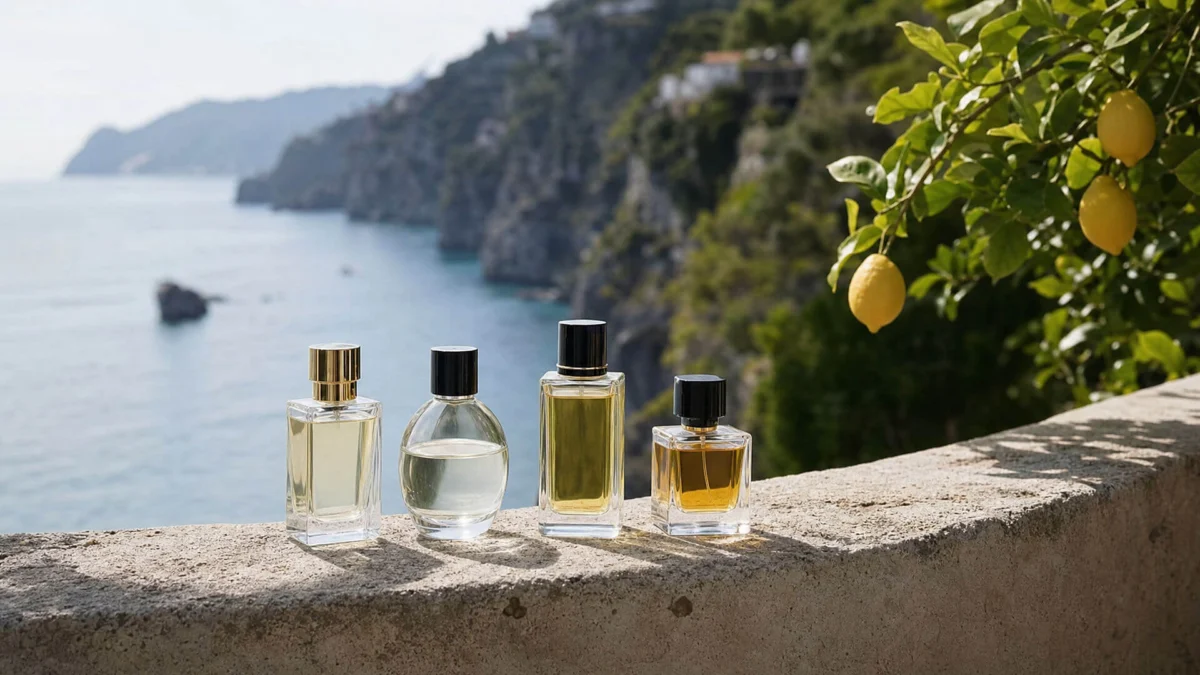
The allure of the Italian Mediterranean has long served as a cornerstone of global luxury tourism, but in recent years, the region’s influence has transcended physical travel to dominate the olfactory landscape. As the Amalfi Coast—a fifty-kilometer stretch of coastline in the Campania region—continues to captivate the international imagination, the fragrance industry has responded by developing sophisticated "liquid postcards." These scents are designed to synthesize the specific atmospheric conditions of the Tyrrhenian Sea: the sharp acidity of Sfusato Amalfitano lemons, the resinous depth of coastal pines, and the mineral-rich salinity of the Mediterranean breeze. This movement toward regional, location-based perfumery represents a significant shift in the luxury market, where consumers increasingly seek "escapist" products that offer a sensory narrative of permanent summer and "quiet luxury."
The Olfactory Geography of the Campania Region
To understand why the Amalfi Coast remains a perennial muse for master perfumers, one must examine the unique microclimate of the region. Designated as a UNESCO World Heritage site in 1997, the coast is characterized by steep limestone cliffs, terraced vineyards, and ancient citrus groves. The olfactory profile of this landscape is not accidental; it is the result of centuries of agricultural tradition.

The "Sfusato Amalfitano," the famous tapered lemon of the region, contains a higher concentration of essential oils in its skin than standard varieties, providing a brighter, more persistent top note for perfumers. When combined with the wild herbs—rosemary, thyme, and fennel—that grow in the crevices of the Lattari Mountains, the resulting aroma is both invigorating and complex. Fragrance houses such as Acqua di Parma, Maison Francis Kurkdjian, and Tom Ford have leveraged these specific chemical markers to create scents that do more than merely smell "fresh"; they recreate the structural feeling of being suspended between the sky and the sea.
Analysis of the "Amalfi Trinity": Three Distinct Olfactory Interpretations
The current luxury market highlights three specific fragrances that exemplify different facets of the Amalfi experience. While they share a geographical inspiration, their chemical compositions and narrative goals vary significantly.
1. The Green-Fruity Hybrid: Blu Mediterraneo Fico di Amalfi by Acqua di Parma
Acqua di Parma, a house with roots dating back to 1916 in the city of Parma, has built its "Blu Mediterraneo" collection as a tribute to the Italian soul. The Fico di Amalfi (Fig of Amalfi) iteration departs from the traditional citrus-only model by centering on the fig tree—a plant that is as much a part of the Italian landscape as the vine.

- The Composition: This fragrance utilizes a complex layering of bergamot, Italian lemon, and grapefruit to simulate the initial blast of coastal morning air. The heart, however, introduces fig nectar combined with pink pepper and jasmine.
- The Technical Achievement: Fig notes in perfumery are often synthetic, as the fruit itself does not yield an essential oil through traditional distillation. Perfumers use molecules like Stemone or Gamma-octalactone to recreate the milky, green, and slightly woody scent of the leaves and fruit. In Fico di Amalfi, the result is a "solar" fragrance—one that feels warm and leathery while maintaining a crisp, aqueous edge.
2. The Herbal Avant-Garde: Aqua Media Cologne Forte by Maison Francis Kurkdjian
Francis Kurkdjian, often cited as one of the most influential perfumers of the 21st century and the current Creative Director of Perfume for Christian Dior, took a more medicinal and herbal approach with Aqua Media Cologne Forte. This scent focuses on the "middle" or "media" of the spectrum, emphasizing green over blue.
- The Composition: It features Calabria bergamot and verbena, but its defining characteristic is the inclusion of sweet Mediterranean fennel and a matcha tea accord.
- Market Context: This fragrance aligns with the "wellness" trend in perfumery. Rather than focusing on seduction or status, Aqua Media focuses on equilibrium. The use of fennel provides a slight anise-like spiciness that mirrors the wild fennel found on the trekking paths of the Sentiero degli Dei (Path of the Gods) overlooking Positano. It represents a move away from "clean" scents toward "living" botanical scents.
3. The Floral Sophisticate: Rose d’Amalfi by Tom Ford
Tom Ford’s "Private Blend" collection is known for its provocative and high-intensity profiles. With Rose d’Amalfi, the brand attempts to marry the romanticism of the Italian rose garden with the salt-sprayed cliffs of the South.
- The Composition: This fragrance centers on a "co-distillation" of roses, supported by Italian bergamot and the almond-like sweetness of heliotrope.
- The Narrative: Unlike the previous two, which are largely gender-neutral, Rose d’Amalfi leans into a "sun-drenched" sensuality. The addition of "baies roses" (pink peppercorns) adds a piquancy that prevents the rose from becoming overly powdery or traditional, mimicking the sharp, bright light of a Mediterranean noon.
Chronology of Olfactory Tourism and the Post-Pandemic Pivot
The history of Amalfi-inspired scents follows a distinct timeline that mirrors the evolution of the global luxury consumer.

- The Early 20th Century: Fragrances were largely regional and centered on the Colonia—a simple blend of citrus and herbs used for hygiene and refreshment.
- The 1990s: The rise of "Calone" (a chemical compound that mimics the smell of the ocean) led to the "Blue" fragrance revolution. Scents became more abstract and watery, losing their connection to specific botanical origins.
- 2010–2019: The "Niche" boom saw houses like Acqua di Parma and Diptyque returning to specific ingredients (the fig, the orange, the neroli) to provide a sense of authenticity.
- 2020–Present: Following global travel restrictions, the demand for "atmospheric" fragrances spiked. Consumers who could not travel to Italy sought to recreate the environment in their homes. This era solidified the "Vacation in a Bottle" as a stable sub-category of the fragrance industry.
Market Data and Consumer Implications
According to recent market reports from organizations like Mordor Intelligence and Euromonitor, the "Niche and Artisanal" fragrance segment is growing at a CAGR (Compound Annual Growth Rate) of approximately 8-10%, outperforming the mass-market designer segment.
A key driver of this growth is the "Scent of Place" phenomenon. Consumers are no longer satisfied with generic "floral" or "oriental" categories; they are purchasing by destination. This has led to a premium pricing model. For instance, the fragrances mentioned—ranging from approximately €165 to over €200—reflect a consumer willingness to pay for the "intellectual property" of a location.
Furthermore, the "Quiet Luxury" or "Old Money" aesthetic that dominated fashion in 2023 and 2024 has a direct olfactory equivalent: the Mediterranean citrus. Unlike heavy ouds or gourmand (sweet) scents, the Amalfi-inspired citrus profile is perceived as understated, sophisticated, and inherently tied to high-socioeconomic status.

Scientific Foundations: Why Scent Transports Us
The efficacy of these fragrances in "transporting" the wearer is rooted in human biology. The olfactory bulb is part of the brain’s limbic system, which is closely associated with memory and emotion. This is known as the "Proustian Effect."
When a fragrance house successfully isolates the chemical markers of a specific environment—such as the salinity of the sea (achieved through molecules like Transluzone) or the heat of the sun on stone (achieved through salicylates)—they are effectively "hacking" the brain’s memory retrieval system. For a traveler who has visited the Amalfi Coast, these scents can trigger a vivid emotional recall of the trip. For those who haven’t, the scents tap into a collective cultural "ideal" of the Mediterranean, constructed through decades of cinema, photography, and literature.
Expert Perspectives and Future Outlook
Industry analysts suggest that the future of Amalfi-inspired perfumery lies in "biotechnology" and "sustainable sourcing." As climate change threatens the traditional citrus harvests of Southern Italy, brands are investing in sustainable farming in Calabria and Sicily to ensure the longevity of their raw materials.

"The challenge for the modern perfumer is to capture the ephemeral," notes a lead analyst in the luxury sector. "Anyone can make a perfume that smells like lemon. The difficulty is making a perfume that smells like a lemon tree at 4:00 PM in Positano after a light rain. That level of specificity is what the modern luxury consumer is buying."
As we look toward the future, the trend of regional specificity is expected to deepen. We may see fragrances move beyond "Amalfi" as a broad concept to focus on specific villages—the damp lemon cellars of Amalfi town, the high-altitude gardens of Ravello, or the glamorous, salt-crusted docks of Positano.
In conclusion, the current obsession with Amalfi-inspired fragrances is more than a fleeting summer trend. It is a sophisticated intersection of chemistry, marketing, and a deep-seated human desire for escapism. By distilling the essence of the Italian coast into glass bottles, luxury houses have created a medium through which the "eternal summer" can be accessed at any time, in any climate, by anyone. However, as the original article wisely notes, the final ingredient in any fragrance is the wearer’s own skin chemistry. A scent may promise a journey to the Mediterranean, but it will always be a unique version of that journey, filtered through the individual.

0 Comments