
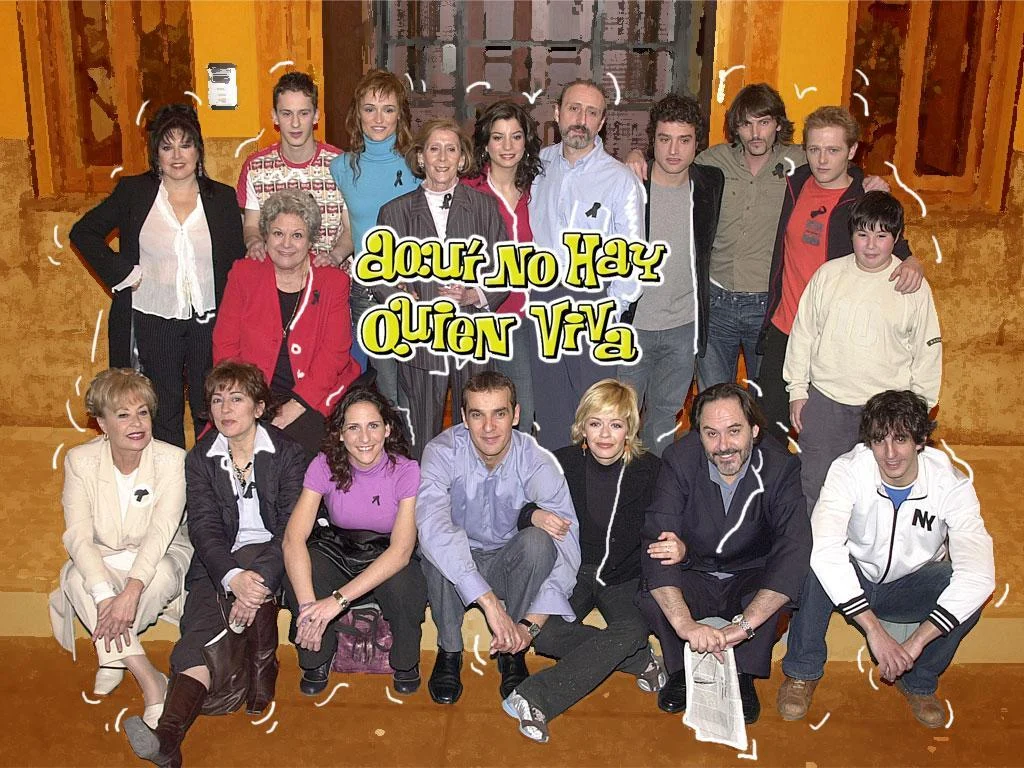
Twenty-two years after its debut, the iconic Spanish television series "Aquí no hay quien viva" continues to resonate, not just with a generation that grew up with it, but with a new wave of digital natives discovering its enduring humor and relatable characters. The phrase "Un poquito de por favor," once a catchphrase uttered by Emilio, the beloved doorman, has transcended its on-screen origins to become a cultural touchstone, circulating through social media, online communities, and even the latest TikTok trends. This enduring popularity begs the question: why does a show that ended its original run over a decade ago continue to capture the zeitgeist, and what does its sustained relevance say about the evolution of Spanish television and comedy?
The genesis of "Un poquito de por favor" is as anecdotal as the show’s own humble beginnings. It wasn’t the product of a meticulously crafted script but rather an off-the-cuff remark overheard by actor Fernando Tejero from a theater colleague during a moment of confusion. This seemingly minor detail encapsulates a significant part of the mystery behind "Aquí no hay quien viva’s" transformation from a network experiment into a television monument. Nothing in its initial conception suggested it would become the enduring phenomenon it is today.
The series, conceived by brothers Alberto and Laura Caballero along with Iñaki Ariztimuño, premiered on Antena 3 on September 7, 2003. The network’s institutional faith in the project was notably scant. Initial plans were for a mere five episodes, with executives subtly pushing for its early demise. This low-stakes beginning belies the explosive success that followed, a rare anomaly in the landscape of mainstream television that is seldom replicated today. On November 24, 2004, the episode titled "Érase un famoso" (Once Upon a Time There Was a Celebrity) captivated an audience of 8,371,000 viewers, achieving an astounding 43.1% market share. The third season consistently averaged close to seven million viewers per episode. In today’s fragmented media environment, characterized by the proliferation of streaming platforms, second screens, and asynchronous viewing habits, such figures belong to a distinctly different era of television consumption.
The pertinent question is not why the show succeeded then, but why it continues to captivate audiences now. The answer lies in a confluence of factors, from its unique production circumstances to its exceptional ensemble cast and its surprising digital afterlife.
A Coral Writing Approach Pushed to the Limit
The phenomenon of "Aquí no hay quien viva" can be attributed to a blend of calculated risk-taking and productive naiveté. Alberto Caballero was only 28 years old when he penned the pilot episode. Iñaki Ariztimuño, meanwhile, immersed himself in the world of building administrators to gather authentic details. The production team worked with an almost superhuman intensity to maintain an unsustainable production rhythm. Scripts were often written concurrently with filming, and once Antena 3 recognized the show’s burgeoning popularity, their demands for new content became insatiable.
Loles León, a prominent cast member, eloquently summarized the pressure in Javier P. Martín’s "Historia oral de Aquí no hay quien viva" (Oral History of Aquí no hay quien viva): "The network wanted, wanted, wanted, and gave no respite. We were all overwhelmed. It was a boom. And a boom, as the word suggests: boom! Everything explodes."
Paradoxically, this very precariousness became an integral part of the show’s magic. "Aquí no hay quien viva" never felt over-written or overly polished. It retained a raw freshness, a testament to being created with haste by talented individuals who had not yet become overly familiar with their own creative formulas. Caballero himself acknowledged this in an interview with elDiario.es in 2023, stating, "I wrote it at 28 or 29 years old, and supposedly, you shouldn’t know how to write well yet. There’s another very good part of unconsciousness that leads you to intuition."
The other decisive factor was the extraordinary ensemble cast. Seventeen principal characters were brought to life by a gallery of actors in peak performance. Malena Alterio transformed Belén into a hero of the downtrodden, José Luis Gil’s portrayal of Juan Cuesta became the definitive monument to Spanish civic mediocrity, Mariano Peña extracted unexpected tenderness from Mauri, and the "three super-girls" – Marisa, Concha, and Vicenta – served as a Greek chorus of Spanish everyday life. And then there was Fernando Tejero as the rocker doorman, a role that was never initially intended for him.
The Small Miracle of Emilio
Tejero was originally contracted to play Paco, the video store owner. It was he who requested a change of role. He recounted the anecdote on Cadena SER: "I told them I lived on Calle Atocha and that my building’s doorman was a rocker. With a fringe like Loquillo’s. Let’s break the stereotype a bit."
This intuition proved to be remarkably accurate. Emilio Delgado’s character resonated because he wasn’t a caricature of a doorman but a hardworking, multi-talented, naive, and good-natured individual whose dignity remained intact, with his heart firmly set on Belén. In many ways, Emilio represents the last endearing archetype of the neighborhood Spaniard that national fiction has managed to construct without resorting to caricature.
Tejero’s relationship with the character today is complex, as is often the case with roles that profoundly mark their interpreters. He expressed his departure from "La que se avecina" (the spiritual successor to "Aquí no hay quien viva") without fanfare: "I’ve made 50 films and have many awards, but most people don’t know that because Emilio and Fermín overshadow everything."

He offered a more nuanced perspective to "Diez Minutos": "It’s surprising and at the same time fantastic that a series made 20 years ago still has such relevance. I’m very proud, although sometimes, depending on how you’re feeling, you’re promoting a film and they say ‘Un poquito de por favor,’ and you think, ‘Hello?’" This sentiment perfectly encapsulates the price of icon status: a shifting balance of gratitude and weariness.
In February 2025, Tejero announced his departure from "La que se avecina" after nearly thirteen years playing Fermín. This marked the end of the Caballero brothers’ direct involvement with that particular narrative arc. Paradoxically, it also returned the full symbolic weight to Emilio, the doorman who inadvertently became the enduring face of the franchise.
The Digital Second Life of Desengaño 21
The key to understanding why this retrospective analysis holds relevance in 2026, and is not merely an exercise in nostalgia, lies in the series’ extraordinary digital afterlife. "Aquí no hay quien viva" is arguably the only Spanish fiction of its generation to enjoy a permanent second run across multiple platforms and social networks. It is simultaneously available on Atresplayer, Netflix, Prime Video, Max, Movistar Plus+, and, as of June 2025, also on Disney+. Atresplayer uniquely preserves the series in its entirety and without censorship. Netflix, for instance, removed the episode "Érase un Belén" due to a blackface incident involving Mariano Delgado dressed as King Balthasar, a decision brought to light by the podcast "Érase una serie."
Then there is TikTok. Hashtags such as #anhqv, #unpoquitodeporfavor, and #radiopatio collectively garner millions of views. Individual videos focusing on specific iconic scenes – Marisa speaking to the spirit of the microwave, Belén’s soggy cookies, Junior’s rap – routinely surpass tens of thousands of likes. The official @atresplayer account, with 757,100 followers and 28.6 million likes, recycles fragments like a radio station programmer. Amateur fan accounts, such as @eraseunaserie, publish clips that achieve peaks of nearly 20,000 likes. The podcast of the same name, hosted by a quartet of commentators, some of whom were not even born when "Aquí no hay quien viva" premiered, has completed over three seasons of chapter-by-chapter analysis on platforms like Spotify, YouTube, and Podimo.
The fact that the series continues to generate revenue is more than mere conjecture. In 2025, the Caballero brothers and Ariztimuño successfully petitioned Mercantile Court No. 18 of Madrid to compel Atresmedia to disclose the actual figures of its digital exploitation. A twenty-two-year-old series does not find itself in legal proceedings unless it continues to generate significant financial returns.
The embrace between Malena Alterio and Fernando Tejero at the 2024 Goya Awards, following her win for Best Actress for "Que nadie duerma," instantly went viral, perceived as a reunion of Belén and Emilio. The death of Gemma Cuervo (Vicenta) on March 14, 2026, triggered a massive outpouring of grief on social media under the poignant slogan, "Today the sky has three peepholes." These are indicators of a phenomenon that has transcended its television origins to become a genuine cultural force.
Why Has No One Been Able to Surpass It?
The question looms over any serious analysis of contemporary Spanish sitcoms: why has no subsequent comedy managed to reach this zenith? The answer is multifaceted and requires careful examination.
The first layer is structural and indisputable. The mainstream prime time slot capable of gathering eight million viewers for a single episode simply no longer exists. The fragmentation of audiences across digital terrestrial television, streaming platforms, and on-demand viewing makes replicating those numbers materially impossible. "La que se avecina," its spiritual successor, entered its seventeenth season in 2026, maintaining enviable vitality but operating on an entirely different scale. The audience share figures comparable to those of 2004 belong to television archaeology.
The second layer is creative, and here, Caballero himself has been candid. "Aquí no hay quien viva" eventually ran out of steam: "the last thirteen episodes were superfluous, because the truth is we were all very tired," he admitted to elDiario.es. "La que se avecina" evolved towards a more acidic and exaggerated humor. Isabel Ordaz, the unforgettable Hierbas, defended the original series with a statement that serves as a diagnosis: "Aquí no hay quien viva" was a situational comedy, a classic sitcom. There were typical characters and typical situations, but within their pettiness, there was tenderness. People had moments of weakness, where it was possible to feel compassion for the other." This collective tenderness, this capacity for empathy towards characters even when they behaved monstrously, is what subsequent sitcoms have gradually lost.
The third layer is the brand itself. The proposed natural sequel, "Atocha 20," never materialized; Caballero has confirmed it was a fan-created concept. The rights are tied to Antena 3, and the creator team has explicitly ruled out a "Friends"-style reunion out of respect for the deceased cast members – Mariví Bilbao, Emma Penella, Eduardo Gómez – and due to the ongoing recovery of José Luis Gil following his stroke in November 2021. Consequently, "Aquí no hay quien viva" has become a closed entity, a fixed cultural artifact from which only fragments can be extracted.
Perhaps this is the true reason for its longevity. Series that aspire to be eternal often falter precisely by striving for it. "Aquí no hay quien viva" concluded when it was timely – arguably, even a little late – and has solidified its legacy as that double album a band never managed to equal again. When Luis Merlo, who played Mauri in the fiction, appeared on "La Revuelta" in September 2025, host Broncano introduced him unequivocally: "possibly, the most important Spanish series of the last decades." This statement is not an exaggeration; it is simply the acknowledgment that twenty-two years later, Desengaño 21 remains the address to which conversations invariably return whenever Spain discusses television comedy.
And for now, it seems no one holds the keys to a better portal.

0 Comments