
 Nila Kartika Wati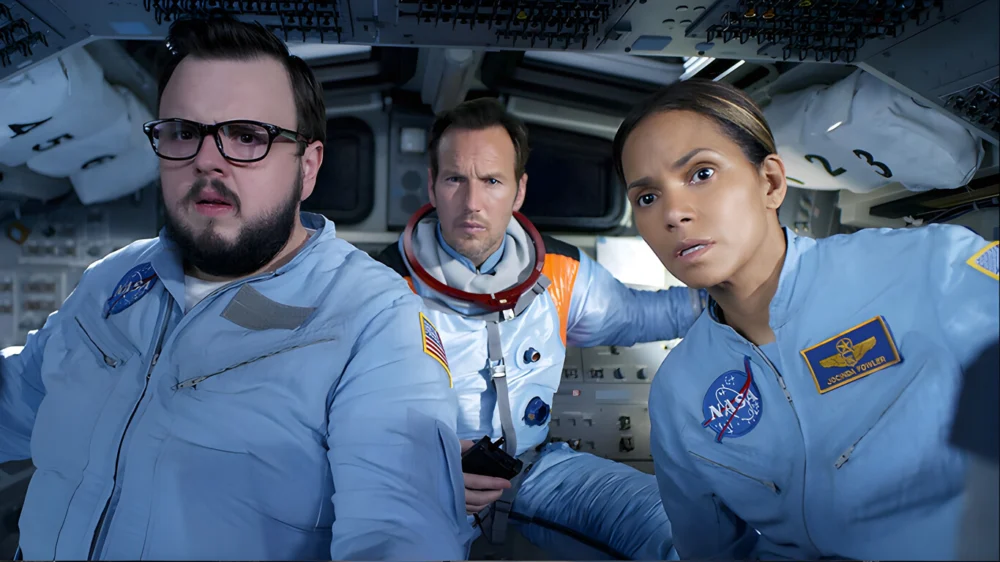
The 2022 science fiction epic Moonfall, directed by Roland Emmerich, represents a significant case study in contemporary cinema, blending massive independent financing with the traditional tropes of the disaster genre. Produced with a budget of approximately $140 million, the film stands as one of the most expensive independent productions ever realized. Despite its ambitious scale and the pedigree of its director—often referred to as the "Master of Disaster" for his work on Independence Day, The Day After Tomorrow, and 2012—the film faced a challenging theatrical environment, ultimately finding a secondary life and renewed relevance through global streaming platforms such as Amazon Prime Video and Max.
Narrative Overview and Thematic Elements
The plot of Moonfall centers on a catastrophic event in which a mysterious force knocks the Moon out of its orbit, sending it on a collision course with Earth. As the satellite draws closer, the resulting gravitational shifts trigger a series of global disasters, including massive tsunamis, atmospheric dissipation, and tectonic instability. The story follows three unlikely protagonists: Jo Fowler (Halle Berry), a NASA executive and former astronaut; Brian Harper (Patrick Wilson), a disgraced former colleague of Fowler; and K.C. Houseman (John Bradley), a conspiracy theorist who is the first to discover the Moon’s orbital decay.

The film distinguishes itself from more grounded science fiction by embracing the "Megastructure" theory, a speculative concept suggesting that the Moon is not a natural celestial body but an artificial construct. This narrative choice allows the film to transition from a standard disaster movie into a high-concept space opera involving ancient artificial intelligence and extraterrestrial origins. While the narrative defies conventional laws of physics and orbital mechanics, it adheres to the maximalist aesthetic that has defined Emmerich’s career for over three decades.
Chronology of Production and Global Release
The development of Moonfall began in early 2019, with Emmerich and his long-time collaborator Harald Kloser co-writing the script. Unlike most Hollywood blockbusters of this scale, which are typically financed by "Big Five" studios like Disney or Warner Bros., Moonfall was funded through a complex web of independent investors and international distribution pre-sales. Lionsgate handled the domestic distribution in the United States, while Huayi Brothers served as a major financier and distributor for the Chinese market.
Principal photography commenced in Montreal in October 2020. The production faced significant logistical hurdles due to the COVID-19 pandemic, which necessitated strict health protocols and contributed to the inflation of the production budget. The filming lasted 61 days, utilizing massive soundstages to recreate the interior of the Space Shuttle Endeavour and the various lunar environments.

The film was released theatrically on February 4, 2022. Its debut coincided with a period of transition in the film industry, as theaters were still struggling to regain pre-pandemic attendance levels and audiences were increasingly gravitating toward established franchise intellectual properties (IP) rather than original, high-concept spectacles.
Financial Performance and Market Analysis
The financial trajectory of Moonfall serves as a cautionary tale regarding the risks of high-budget independent filmmaking in the 2020s. According to data from Box Office Mojo, the film earned approximately $10 million during its opening weekend in the United States, finishing second behind Jackass Forever. By the end of its theatrical run, Moonfall had grossed $19.1 million domestically and $48.2 million internationally, for a global total of $67.3 million.
When measured against its $140 million production budget and an estimated $30 million to $50 million marketing spend, the film resulted in a significant loss for its equity investors. Industry analysts from Variety and The Hollywood Reporter categorized the film as one of the largest "bombs" of 2022. Several factors contributed to this outcome:

- Competition and Timing: The film was released shortly after Spider-Man: No Way Home, which continued to dominate the box office, siphoning away the demographic interested in visual-effects-heavy spectacles.
- The Decline of Original IP: Market trends indicated a dwindling appetite for non-franchise disaster films, a genre that peaked in the late 1990s and early 2000s.
- Critical Reception: The film holds a 35% approval rating on Rotten Tomatoes. Critics generally praised the visual effects but criticized the dialogue and the increasingly convoluted plot, which likely hindered word-of-mouth recommendations.
Technical Execution and Visual Effects
Despite the commercial underperformance, the technical achievements of Moonfall are noteworthy. The visual effects (VFX) were handled by several leading houses, including Scanline VFX, Framestore, and Pixomondo. The production required the creation of "gravity waves"—a visual representation of the Moon’s gravitational pull lifting objects off the Earth’s surface—which demanded sophisticated fluid and particle simulations.
Emmerich’s direction emphasized practical sets where possible, including a meticulously detailed cockpit of the Space Shuttle. The integration of NASA-consulted designs with purely fantastical elements created a unique visual contrast. This commitment to high-end production values is a hallmark of Emmerich’s style, ensuring that even when the narrative logic is questioned, the sensory experience remains at a professional blockbuster standard.
Statements and Industry Reactions
Following the film’s release, Roland Emmerich voiced his concerns regarding the state of the film industry and the dominance of major franchises. In an interview with Den of Geek, Emmerich noted that the prevalence of Marvel and Star Wars films has made it increasingly difficult for original ideas to find a foothold in the theatrical market. He argued that the "destruction" of the medium comes from a lack of variety, suggesting that audiences are being conditioned to only support established brands.

Scientific commentators also weighed in on the film’s premise. While NASA provided some technical assistance regarding the appearance of equipment and mission control, the agency clarified that the film’s central conceit—the Moon falling—is physically impossible under the current laws of the universe. However, some astronomers noted that the film’s use of the "Hollow Moon" conspiracy theory served as an interesting, if scientifically inaccurate, narrative device to explore "what if" scenarios.
Broader Impact and the "Streaming Second Life"
In the months following its theatrical exit, Moonfall transitioned to digital rental and streaming services. It is in this environment that the film began to find a more receptive audience. On platforms like Prime Video and Max, the film frequently appeared in "Top 10" lists in various territories.
The phenomenon of the "streaming second life" is a documented trend where films that failed to attract audiences at a premium theatrical price point become highly consumed when included as part of a subscription. For Moonfall, the lack of narrative complexity and the emphasis on visual spectacle made it ideal "second-screen" content—movies that viewers can enjoy without requiring intense intellectual engagement.

The legacy of Moonfall is twofold. First, it represents the potential end of an era for the mega-budget independent disaster film, as investors may be hesitant to back similar projects without the safety net of a major studio or an existing IP. Second, it reinforces the importance of streaming platforms in the lifecycle of a modern film, providing a venue for recouping losses and reaching audiences that have moved away from the traditional cinema-going experience.
Conclusion and Future Implications
Moonfall remains a polarizing entry in Roland Emmerich’s filmography. It is a work that prioritizes the "spectacle of destruction" over narrative cohesion, a choice that has historically served Emmerich well but met with diminishing returns in 2022. As the industry continues to consolidate around safe, recognizable franchises, Moonfall stands as a testament to the sheer ambition of independent creators willing to gamble on original, albeit eccentric, concepts.
For the viewer, the film offers a pure distillation of the disaster genre: high stakes, global scale, and a total suspension of disbelief. Whether viewed as a flawed experiment or a misunderstood piece of popcorn cinema, its presence on major streaming services ensures that the "world burning" under Emmerich’s direction will continue to be witnessed by millions, long after its initial theatrical disappearance. The film’s journey from a $140 million theatrical risk to a streaming staple highlights the evolving nature of how global audiences consume big-budget entertainment in the 21st century.




 Eva Lovia
 Julia Chirkova
 Julia Prastini
 Jia Lissa
 admin
admin