
 Raisa Andriana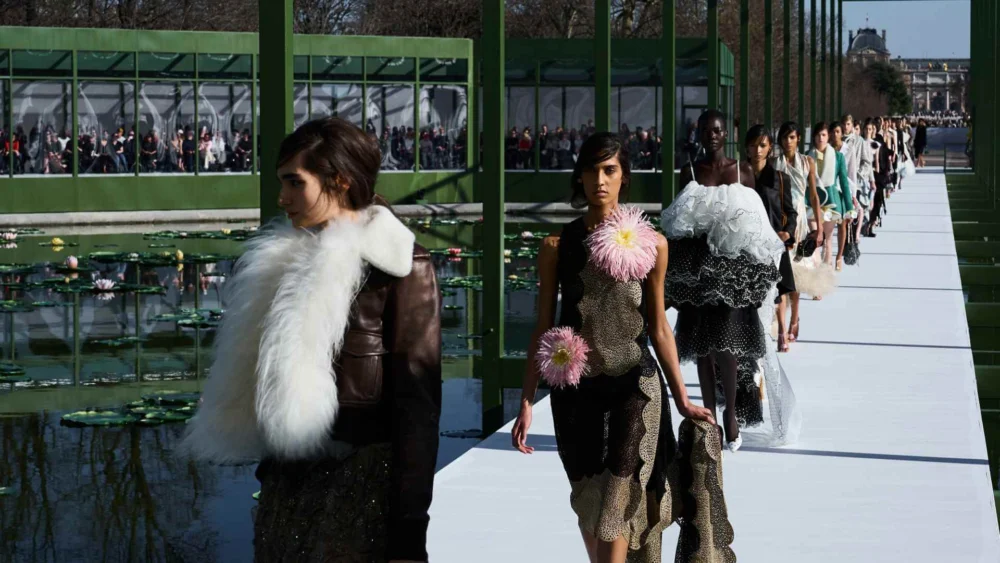
Historical Context: The Tuileries as a Sartorial Stage
The choice of the Jardin des Tuileries as the venue was far from coincidental. Originally commissioned by Catherine de’ Medici in 1564 and later redesigned by André Le Nôtre under the reign of Louis XIV in 1664, the gardens represent the pinnacle of French formal landscaping. For Dior, a brand whose founder, Christian Dior, was famously obsessed with his gardens in Granville, the Tuileries provided a symbolic link between the monarchy of the past and the luxury of the present.
The garden has long been one of the most visited public spaces in France, but for the Fall-Winter 2026-2027 show, it was transformed into a private, enchanted sanctuary. The centerpiece of the scenography was the iconic octagonal fountain, which was modified for the event. The water’s surface was covered in thousands of artificial water lilies, creating a surrealist landscape that mimicked the Impressionist works of Claude Monet while serving as a direct reference to the garments on the runway.

Jonathan Anderson’s Third Act at Dior
Since his appointment as Creative Director, Jonathan Anderson has been tasked with navigating the delicate balance between Dior’s mid-century heritage and the avant-garde sensibilities that defined his tenure at Loewe and his eponymous label. This Fall-Winter collection represented his most cohesive vision to date. If his debut was an introduction to a new silhouette, and his Couture show was a tribute to the technical prowess of the petites mains, this ready-to-wear collection was about wearability infused with "organic magic."
Industry analysts have noted that Anderson’s arrival at Dior signaled a shift away from the feminist-slogan era of his predecessor, moving toward a more abstract, sculptural form of fashion. This collection emphasized the "movement of life," utilizing fabrics that responded to the wearer’s stride, creating a dialogue between the garment and the environment.
The Central Motif: From Cyclamen to Water Lilies
While floral themes are a staple of the Dior identity, Anderson’s approach has been specific and evolutionary. In his January 2026 Haute Couture collection, the cyclamen was the primary focus—a subtle nod to the flamboyant era of John Galliano. For the Fall-Winter 2026-2027 season, the focus shifted to the water lily (nenúfar).

According to official statements from the Maison, the space was designed to reflect an "interconnected ecosystem." The water lilies seen in the fountain were mirrored in the textiles through a variety of high-tech and traditional techniques. "The surface of the iconic octagonal fountain bloomed with artificial water lilies, while the floral prints of the garments reproduced the real flowers of the gardens," a Dior spokesperson noted during the post-show briefing. This literal and metaphorical blooming was woven into the very fabric of the collection, with silk prints and 3D embroideries mimicking the texture of aquatic plants.
Technical Analysis of the Collection
The Fall-Winter 2026-2027 collection was characterized by its "organic" construction. Anderson utilized several key design elements to achieve this:
1. Floating Volumes and Tulle
The use of tulle was pervasive, but not in the traditional "princess" sense. Instead, it was layered to create weightless volumes that seemed to hover around the models. This technique allowed for silhouettes that were both expansive and ethereal. The garments were engineered to be self-supporting, moving with a natural fluidity that suggested they were floating in water.

2. The Return of the Peplum
One of the most striking technical features was the reintroduction of the peplum. However, Anderson’s version was modernized; rather than a stiff attachment at the waist, these peplums were integrated into the architecture of coats and dresses, creating soft, undulating waves that echoed the ripples of the Tuileries fountain.
3. The Green Palette
The color story was dominated by varying shades of green—from deep forest and moss to the pale, translucent green of a lily pad. This choice served as the "connective tissue" of the collection, grounding the more fantastical elements in an earthy, recognizable reality. The integration of green was not limited to the clothing; it extended to the accessories, including structured handbags and footwear that featured organic, vine-like detailing.
A Dialogue with the Archive: Reimagining the Junon Dress
Perhaps the most discussed aspect of the show was Anderson’s direct engagement with the Dior archives. Specifically, the collection featured several reinterpretations of the "Junon" dress. Originally designed by Christian Dior for the Fall-Winter 1949-1950 collection, the Junon is famous for its skirt of ombré petals, meant to resemble the plumage of a peacock (the bird of the goddess Juno).

Anderson took the petal-like construction of the Junon and translated it into contemporary ready-to-wear. By using laser-cut fabrics and modern bonding techniques, he recreated the "petal" effect on shorter dresses and even structured jackets. This move was seen by critics as a successful attempt to "future-proof" the brand’s history, taking a 75-year-old concept and making it relevant for the 2027 market.
Chronology of the Presentation
The event followed a meticulously planned sequence that enhanced the narrative of a "day in the garden":
- 19:00 – Arrival: Guests arrived at the Tuileries as the sun began to set, the artificial water lilies in the fountain glowing with internal LED lights.
- 20:18 – Opening Look: The show began with a stark, moss-green tailored coat, establishing the organic theme immediately.
- 20:30 – The Floral Transition: The middle section of the show introduced the water lily prints, with models walking in a rhythmic pace that emphasized the "floating" nature of the tulle skirts.
- 20:45 – The Archival Finale: The closing looks featured the Junon-inspired gowns, transitioning from earthy greens to iridescent blues and silvers, mimicking the change of light on water.
- 20:55 – Final Walk: Jonathan Anderson took his bow against the backdrop of the fountain, marking the conclusion of what many are calling his "definitive" collection for Dior.
Industry Reaction and Market Implications
The reaction from the fashion community has been overwhelmingly positive. Retail buyers from major luxury hubs—including New York, Tokyo, and Dubai—have praised the collection for its balance of artistic merit and commercial viability. The "organic luxury" trend, which Anderson has championed, is expected to influence the broader market throughout 2027.

"Anderson has managed to do something very difficult," noted one veteran fashion critic. "He has taken the ‘Garden-Woman’ concept of Monsieur Dior and stripped away the nostalgia, replacing it with a modern, almost biological vitality. These aren’t just clothes; they are a study of how humans interact with nature in an increasingly digital world."
From a business perspective, the collection is expected to drive significant growth in Dior’s leather goods and ready-to-wear sectors. The focus on "garments that hold themselves up" suggests a move toward high-quality, investment-grade fashion that appeals to a consumer base increasingly concerned with craftsmanship and longevity.
Broader Impact: The Future of Dior
The Fall-Winter 2026-2027 show confirms that Dior is entering a new golden age under Jonathan Anderson. By anchoring his creative vision in the physical reality of the Tuileries and the historical reality of the Dior archive, he has created a brand identity that is both stable and innovative.

The collection also highlights a broader shift in Paris Fashion Week toward immersive storytelling. As luxury brands compete for attention in a crowded global market, the ability to create a "universe"—as Anderson did with his enchanted garden—becomes as important as the design of the clothes themselves. As the fashion world looks toward the Spring-Summer 2027 season, the benchmark has been set high: a fusion of history, nature, and technical brilliance that honors the past while firmly grasping the future.


 Julia Prastini
 Nila Kartika Wati
 Jia Lissa
 admin
admin
 Pevita Pearce