
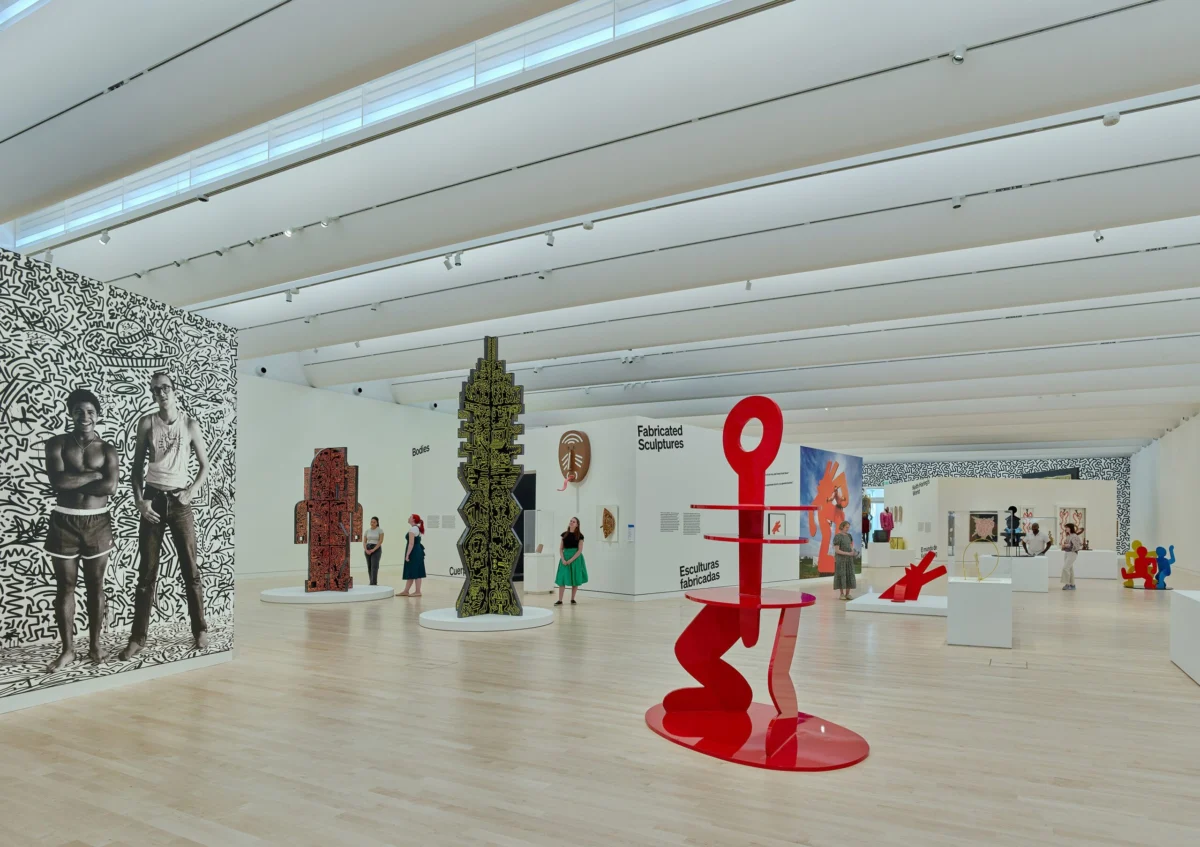
For nearly four decades, the global perception of Keith Haring has been defined by the singular power of his line. From the kinetic energy of his "Barking Dog" to the rhythmic silhouettes of his "Radiant Baby," Haring’s iconography—born in the chalk drawings of the New York City subway system in the early 1980s—has become one of the most recognizable visual languages in modern history. However, this ubiquity of his two-dimensional work has historically overshadowed a significant portion of his creative output: his exploration of volume, space, and the three-dimensional form. This oversight is currently being addressed by the Crystal Bridges Museum of American Art in Bentonville, Arkansas, through its landmark exhibition, "Keith Haring in 3D." Running until January 25, 2027, the exhibition serves as the inaugural showcase for the museum’s newly expanded temporary gallery space, signaling a major re-evaluation of Haring’s legacy.
The exhibition represents the first comprehensive institutional effort to focus exclusively on Haring’s sculptural practice. While Haring produced hundreds of three-dimensional works during his brief but prolific career, they have rarely been gathered at this scale. The show features a meticulous selection of works drawn from prestigious private collections and international institutions, offering a rare look at how the artist translated his signature graphic style into steel, bronze, wood, and found objects. By moving beyond the flat surface of the canvas or the wall, "Keith Haring in 3D" invites viewers to experience the physical presence of his characters, which take on new political and social dimensions when they occupy the same physical space as the audience.

The Technical and Creative Evolution of Haring’s Sculpture
Keith Haring’s journey into the third dimension was not an immediate pivot but a gradual evolution rooted in the collaborative spirit of the 1980s East Village art scene. According to art critic Carlo McCormick, Haring did not initially view himself as a traditional sculptor. His transition began through interventions on everyday objects, often in collaboration with his peer and roommate, Kenny Scharf. Together, they treated the world as a canvas, applying Day-Glo paint and intricate patterns to televisions, appliances, and furniture. This early phase of "object transformation" laid the groundwork for a more formal engagement with volume.
The exhibition documents the pivotal role of figures like Tony Shafrazi, the gallerist who facilitated Haring’s transition from the "underground" subway scene to the high-stakes world of international galleries. In 1982 and 1983, Shafrazi’s exhibitions began to showcase how Haring’s drawings could inhabit space. By 1985, Haring had reached a level of technical maturity that allowed him to work with the Lippincott foundry, a renowned facility in Connecticut that helped realize the large-scale, brightly colored steel sculptures that would eventually become public landmarks. Working alongside his childhood friend and studio director, Kermit Oswald, Haring experimented with totemic forms and modular structures, proving that his "line" could maintain its vitality even when cast in heavy metal.
A Scholarly Correction: The Monacelli Monograph
Accompanying the exhibition is a significant scholarly volume published by Phaidon/Monacelli. Edited by longtime Haring collector Larry Warsh and independent curator Glenn Adamson, the book serves as a historical correction to the artist’s narrative. It features essays from a "who’s who" of art history and criticism, including Robert Storr, Lowery Stokes Sims, Dieter Buchhart, David Galloway, and Francis Naumann.

In the book’s introduction, Larry Warsh explains that the publication is the culmination of nearly forty years of personal collecting and research. He notes that the three-dimensional works—ranging from delicate vases to massive public monuments—encapsulate a dynamic force that is often lost in flat reproductions. The monograph situates these works within the "Downtown" scene of the late 70s and early 80s, a period defined by the cross-pollination of graffiti, hip-hop, punk, and fine art. A highlight of this historical reconstruction is the "Fun Fridge," a refrigerator from Patti Astor’s legendary Fun Gallery that was collaboratively intervened upon by Haring, Jean-Michel Basquiat, Kenny Scharf, and Fab Five Freddy. Such objects serve as living documents of a specific cultural moment where the boundaries between "high" and "low" art were being systematically dismantled.
The Intersection of Fashion, Design, and Public Access
The exhibition at Crystal Bridges highlights the sheer diversity of Haring’s 3D output. Beyond traditional sculpture, the galleries display ceramics, carved wood, and domestic items transformed by his graphic touch. Haring’s vision extended into the realm of functional art and fashion, evidenced by his collaborations with designers such as Stephen Sprouse, Vivienne Westwood, and Patricia Field. His work for the stage is also represented, including sets designed for choreographer Bill T. Jones and the iconic singer Grace Jones.
One of the most spectacular examples of Haring’s commitment to public, immersive art was his participation in "Luna Luna," the world’s first traveling art amusement park. Mounted in Hamburg in 1987 by André Heller, the project featured a carousel designed by Haring, which critics at the time hailed as "the museum of the future." This ethos of accessibility culminated in the 1986 opening of the Pop Shop in Manhattan. By selling posters, buttons, and t-shirts at affordable prices, Haring bypassed the traditional gatekeepers of the art market, ensuring his work could be owned by the public he so often depicted.

Crystal Bridges and the Expansion of American Art
The timing of "Keith Haring in 3D" is significant for the Crystal Bridges Museum of American Art. The exhibition coincides with the unveiling of a 10,500-square-meter expansion designed by Safdie Architects. This expansion increases the museum’s overall size by 50%, a move intended to accommodate growing visitor numbers and an increasingly diverse collection. Founded in 2011 by philanthropist Alice Walton, Crystal Bridges has quickly become a cornerstone of the American cultural landscape, particularly in the South.
As the museum celebrates its 15th anniversary, it is embarking on a broader project to redefine the "American" in American art. This initiative, titled "Visions of America," seeks to move beyond a monolithic narrative of art history. By placing Haring’s work—deeply rooted in queer identity, social activism, and urban culture—at the center of its new galleries, the museum is making a statement about the inclusivity of the national canon. This is further reflected in the museum’s permanent collection, which has seen a steady increase in the representation of Latin American, Latino, Indigenous, and African American artists.
Political Relevance and Contemporary Resonance
The exhibition makes a compelling case for the continued relevance of Haring’s work in the 21st century. While his forms are often playful, they grapple with heavy themes: the AIDS crisis, the threat of nuclear war, environmental degradation, systemic racism, and the rise of consumer capitalism. Curators note that Haring’s 3D objects should not be viewed as mere extensions of his drawings but as autonomous works that engage with the physical world’s politics.

Victor Gomez, associate curator at Crystal Bridges, emphasizes that the show aims to peel back the layers of Haring as a "pop icon" to reveal the complexities of his personal and political life. In an era where public art and community-based activism are once again at the forefront of cultural discourse, Haring’s model of the artist-as-activist resonates with renewed intensity. His work remains a "language without borders," a sentiment that aligns with the museum’s mission to foster a more continental and less restrictive understanding of American creativity.
Chronology of Keith Haring’s Three-Dimensional Milestones
- 1978: Keith Haring moves to New York City to study at the School of Visual Arts, immersing himself in the East Village scene.
- 1980–1982: Begins transforming found objects (TVs, refrigerators) with Kenny Scharf at the Fun Gallery.
- 1982: First major solo exhibition at Tony Shafrazi Gallery, introducing his work to the global market.
- 1983: Participates in the Whitney Biennial; begins experimenting with more permanent sculptural materials.
- 1985: Collaborates with the Lippincott foundry to create large-scale painted steel sculptures for an exhibition at Leo Castelli Gallery.
- 1986: Opens the Pop Shop in New York, a retail environment designed as a total 3D artwork.
- 1987: Designs the carousel for André Heller’s "Luna Luna" in Hamburg.
- 1990: Keith Haring passes away at age 31 due to AIDS-related complications, leaving behind a massive archive of public and private works.
- 2024: "Keith Haring in 3D" opens at Crystal Bridges, marking the first major institutional focus on his sculptural career.
As the exhibition continues through the 250th anniversary of the United States in 2026, it invites a reflection on the role of the artist in society. By bringing Haring’s sculptures to the heart of the American South, Crystal Bridges is not only honoring a legacy but also challenging the geography of art history, ensuring that the "line" Haring started in the New York subways continues to move, grow, and take shape for new generations.

0 Comments