
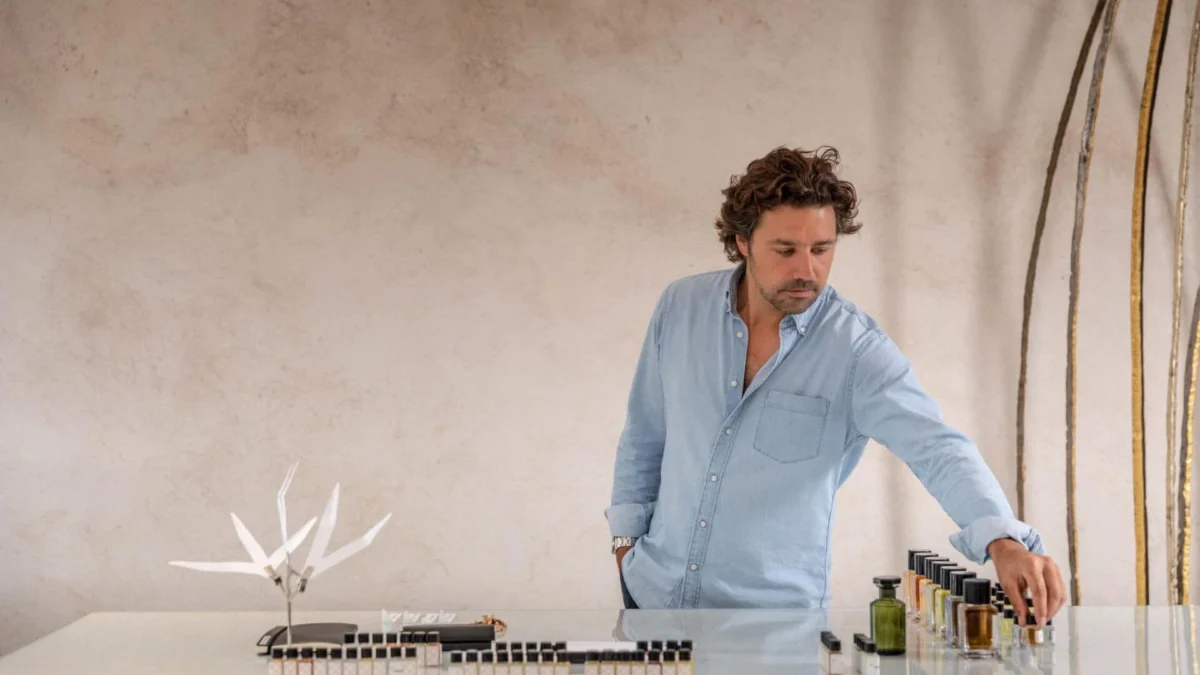
The global fragrance industry, currently valued at approximately $58 billion and projected to grow at a compound annual growth rate (CAGR) of 5.9% through 2030, is witnessing a profound shift in consumer priorities. For decades, the sector was dominated by monolithic fashion houses and celebrity-backed marketing campaigns where the olfactory juice often played second fiddle to the bottle’s design or the face of the brand. However, a new paradigm is emerging, spearheaded by creators who prioritize the "sourcing" of ingredients over the "storytelling" of advertising. At the forefront of this movement is Aurélien Guichard, the co-founder and creative director of Matière Première, a French perfume house that has positioned itself as a vanguard of transparency and ingredient-centric luxury since its inception in 2019.
Guichard’s approach is fundamentally disruptive because it dismantles the traditional hierarchy of perfume production. In a world where artificial intelligence and synthetic replication are increasingly used to "smooth out" the complexities of natural scents, Matière Première chooses to celebrate the inherent imperfections and visceral realities of the soil. The brand’s philosophy, translated literally as "Raw Material," suggests that the ultimate luxury is not found in a polished marketing narrative but in the ancestral link between the perfumer, the farmer, and the land.

A Chronology of Craft and the Birth of Matière Première
To understand the trajectory of Matière Première, one must look at the lineage of its creator. Aurélien Guichard is a seventh-generation perfumer born in Grasse, the world’s perfume capital. His family history is intertwined with the cultivation of jasmine, rose, and verbena, providing him with an education that was as much agricultural as it was chemical. Before launching his own house, Guichard established himself as one of the industry’s most prolific "noses," creating world-renowned scents for brands such as Gucci, Narciso Rodriguez, and Issey Miyake.
Despite his success in the commercial sector, Guichard identified a growing disconnect between the laboratory and the field. In 2019, alongside co-founders Fabien Clar and Caius von Knorring, he launched Matière Première with a radical mandate: to put the primary ingredient back into the center of the olfactory experience. Unlike many houses that outsource their raw materials to global conglomerates, Guichard took the unprecedented step of becoming a grower himself. In 2016, he established an organic farm in the Grasse region, specifically to cultivate Rosa Centifolia and Tuberose. This vertical integration allows the brand to control the quality of its ingredients from the moment the seed is planted to the final bottling process.
The timeline of the brand’s expansion reflects a steady, deliberate growth. Following the initial launch of its core collection in 2019, Matière Première survived the global retail challenges of the pandemic by leaning into the "clean beauty" and "niche fragrance" trends, which saw a surge as consumers sought more personal, high-quality experiences during lockdowns. By 2023 and early 2024, the brand had successfully expanded its physical footprint beyond France, establishing flagship presence in London’s Covent Garden and Berlin’s Mitte district, signaling a robust appetite for high-concentration, artisanal perfumery in Europe’s most competitive markets.

The Technical Architecture of Ingredient-Centric Fragrance
The distinction of Matière Première lies in its technical formulation. In traditional perfumery, a "hero" ingredient mentioned in marketing might only exist in trace amounts within the actual liquid. Guichard’s methodology reverses this. Each fragrance in the collection is built around a single primary ingredient, which is used in exceptionally high concentrations. This approach requires a masterful hand; natural ingredients are chemically complex and can become overwhelming or unstable if not balanced with precision.
For instance, "Radical Rose" features the highest concentration of Rose Centifolia absolute in the world. By pushing the boundaries of what is chemically possible, Guichard allows the wearer to experience the multi-faceted nature of the flower—its spiciness, its earthiness, and its honey-like sweetness—rather than a sanitized, synthetic version. Similarly, "Crystal Saffron" utilizes Greek saffron from the Kozani region, which is widely considered the highest quality saffron globally. The fragrance explores the transparency of the spice, stripping away the heavy, leathery notes often associated with saffron to reveal a luminous, crystalline texture.
Supporting data from the luxury sector suggests that this "transparency" is exactly what modern consumers are willing to pay a premium for. A 2023 report by McKinsey & Company on the beauty industry highlighted that "niche" and "prestige" fragrance categories are outperforming the mass market, driven by a younger demographic (Gen Z and Millennials) that values ingredient origin, sustainability, and "olfactory signatures" that feel unique rather than mass-produced. Matière Première’s price points—ranging from 170 euros for 50ml to 250 euros for 100ml—place it firmly within this prestige tier, yet the brand’s growth suggests that the "value" is perceived in the concentration and quality of the juice rather than the logo on the box.

Retail Strategy and the Minimalist Aesthetic
The brand’s physical expansion into Paris, London, and Berlin serves as a physical manifestation of its "simplicity as sophistication" mantra. The flagship boutique at 306 Rue Saint-Honoré in Paris serves as the blueprint for the brand’s retail identity. Eschewing the opulent, often intimidating decor of traditional Parisian perfumeries, the space is clinical yet warm, focusing on the bottles themselves.
In Berlin, the store located at Alte Schönhauser Str. 41 in Mitte reflects the city’s industrial and avant-garde spirit, while the London Covent Garden location caters to a global audience of fragrance connoisseurs. These spaces are designed to be educational. Consumers are encouraged to learn about the sourcing of the vanilla from Madagascar, the sandalwood from Australia, and the ambrette from Peru. This educational component is vital; it transforms the act of purchasing a perfume into an act of supporting a global agricultural ecosystem.
As Guichard frequently notes, "The origin of an ingredient is my first creative act." This statement highlights a shift in the role of the perfumer from a chemist to a curator of nature. By focusing on a "minimalist" retail environment, the brand ensures that the olfactory experience remains the primary stimulus, mirroring the way the fragrances themselves are formulated to be clear, direct, and deep.

Official Responses and Market Implications
The industry response to Matière Première has been one of both curiosity and validation. Critics have praised Guichard for his "bravery" in exposing the raw mechanics of his craft. In an industry where "trade secrets" are often used to mask the use of cheap synthetics, Matière Première’s open-book approach to ingredient concentration and sourcing is seen as a challenge to the status quo.
Market analysts suggest that the success of Matière Première is indicative of a broader "de-marketing" of luxury. As digital spaces become saturated with AI-generated imagery and hyper-filtered lifestyles, there is a counter-movement toward "the real." This is particularly evident in the way Guichard discusses his work. He speaks of the weather patterns in Grasse, the texture of the soil, and the hands of the farmers who harvest the crops. This narrative resonates with a global consumer base that is increasingly concerned with the ethical and environmental footprint of their luxury goods.
Furthermore, the brand’s commitment to high concentrations—often reaching 20% to 25%—addresses a common consumer complaint regarding the longevity of modern perfumes. By providing a product that lasts longer on the skin due to the quality of its base materials, Matière Première builds a level of brand loyalty that marketing alone cannot sustain.

Broader Impact and the Future of the Fragrance Industry
The implications of Matière Première’s success extend beyond the niche fragrance market. It serves as a case study for the "premiumization" of agriculture. By proving that consumers will pay for the quality of a specific rose harvest or a particular type of saffron, Guichard is providing a blueprint for how luxury can support sustainable farming practices. When a perfumer uses a high proportion of a natural ingredient, they are directly supporting the biodiversity of the region where that ingredient is grown and providing economic stability to the communities that cultivate it.
Looking forward, the fragrance industry is likely to see more "nose-led" brands that prioritize the supply chain. The era of the "faceless" perfume is waning. In its place, we are seeing the rise of the "Perfumer-Creator" who is as comfortable in a field of flowers as they are in a laboratory.
The future of luxury, as defined by Aurélien Guichard, is one of radical honesty. It is a future where technology is used not to replace nature, but to highlight its brilliance. By returning to the "Matière Première," the industry is not moving backward; it is reclaiming a sense of soul and authenticity that was nearly lost in the noise of the 21st-century marketplace. As the brand continues its global expansion, its core message remains unchanged: the most sophisticated thing a human can do is to step back and let the earth speak for itself.

0 Comments