
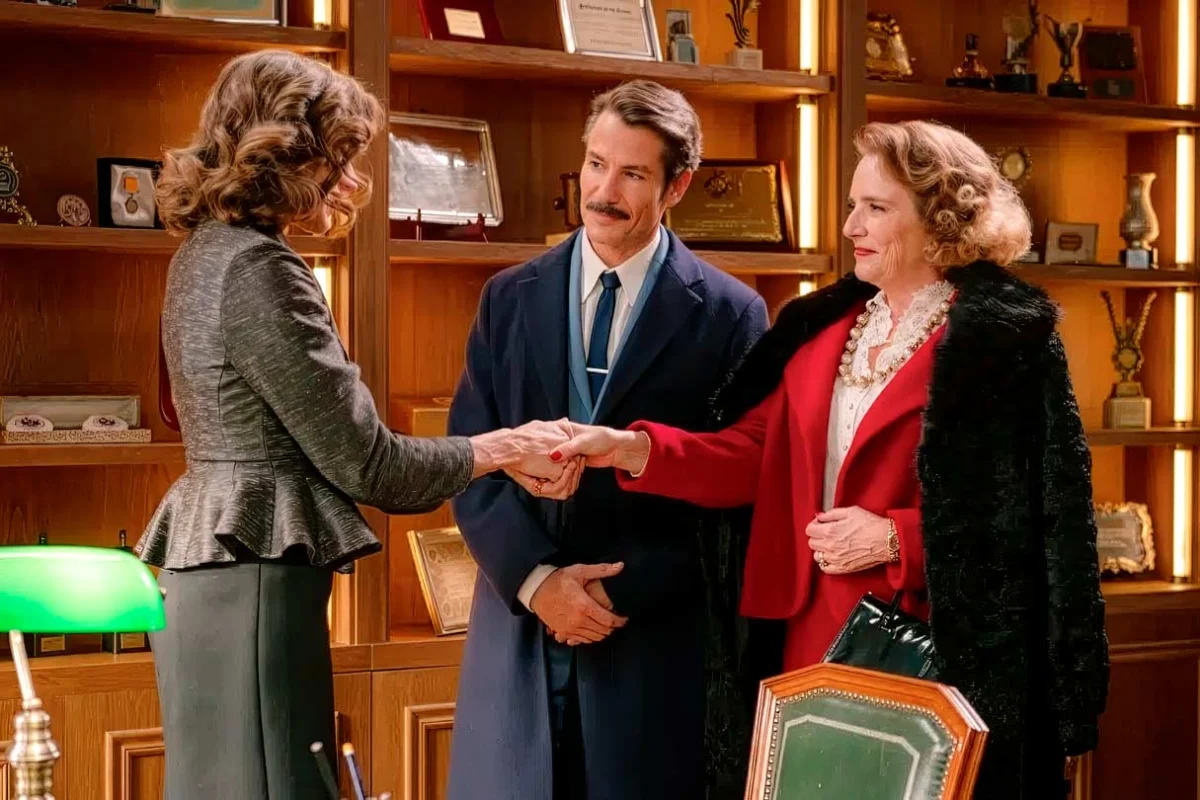
Veteran actress Marta Calvo, a respected figure in Spanish cinema, television, and theater, recently sat down for an in-depth conversation about her current role as Doña Clara in the popular Antena 3 series ‘Sueños de Libertad.’ The interview, conducted by Cultura en Serie, delved into Calvo’s portrayal of the formidable matriarch, her reflections on her extensive career, the current state of the acting profession, and her anticipation for upcoming theatrical projects. Calvo, born in Barcelona in 1962, brings a wealth of experience to her character, a woman of strong character and sharp wit navigating the complexities of Spain in the late 1950s.
Doña Clara: A Forward-Thinking Matriarch in a Restrictive Era
In ‘Sueños de Libertad,’ Marta Calvo embodies Doña Clara, the mother of Pelayo Olivares, played by Alejandro Albarracín. Doña Clara is depicted as a woman of considerable influence and unwavering resolve, fiercely protective of her son and his aspirations for political advancement. A central theme in her character’s narrative is her proactive approach to her son’s homosexuality, a clandestine matter in the Spain of that era. Doña Clara endeavors to guide Pelayo, ensuring his sexual orientation does not become an impediment to his societal and political ambitions.
Calvo expressed deep admiration for her character, describing Doña Clara as "a woman far ahead of her time." She elaborated on this sentiment, stating, "She is a mother who suffers for her son, and for Marta in this case. And Marta [Belmonte’s character] is very likeable to her, from the very first moment. She sees her as a woman like herself, a determined woman, an autonomous woman, and she admires her." This perspective highlights Doña Clara’s progressive mindset, particularly her acceptance and support of her son in a society that often condemned such differences. The character’s business acumen, inherited after her husband’s passing, further underscores her independence and resilience.
A Celebrated Career and the Challenges for Women Over 40
With a career spanning film, television, theater, and voice acting, Marta Calvo is a testament to dedication and talent. The Barcelona-born actress reflected on her current career stage with a mixture of contentment and pragmatic awareness of the industry’s inherent challenges, especially for women. "I am very happy, mainly because I have been able to reach the point I am at," Calvo stated. "This is a long game, and many colleagues, many women, have fallen by the wayside, because things start to get tough after 40, quite tough: there are fewer and fewer roles, and there are quite a few actresses of the same age… so, reaching this point is also something to celebrate."
Calvo candidly addressed the industry’s tendency to marginalize actresses past a certain age. "I celebrate it, I am very happy, without downplaying what I am telling you," she continued. "I work less and less, and after 50 years old, we are absolutely invisible, and there are very few roles. It’s starting to change a little, but there’s still a long way to go." She noted that roles for older actresses often fall into supporting categories, frequently as mothers or grandmothers, primarily serving to support male characters. This observation points to a broader societal and industry-wide issue of underrepresenting the lived experiences and potential of women over 50. Despite these challenges, Calvo remains committed to her craft, expressing gratitude for the continued opportunities to work in her profession.

The "Golden Age" of Daily Series and the Rigors of Production
Having previously starred in daily series such as ‘Servir y Proteger,’ ‘Laberint d’ombres,’ and ‘Amar en tiempos revueltos,’ Calvo offered her perspective on the current "golden age" of this genre. "I think it’s ideal," she remarked. "Everything that is done in the profession seems wonderful to me, because there is always an audience for everything, and everything has its place and gives work to a great many people."
Calvo highlighted the demanding nature of daily serial production, emphasizing its value as a training ground for actors. "A few years ago, there were actors or actresses who dedicated themselves only to cinema and did not touch television, because it was looked down upon a bit, it was like the little brother. And then, when roles started to become scarce or there were fewer opportunities in cinema, people who were not accustomed to doing series (let alone daily ones), opted to do series, and it is an absolutely dignified job where you learn a tremendous amount." She humorously added, "When an actor or actress goes through a daily series, everything else seems very easy (laughs). Everything is against the clock, you have to study a lot for the next day, and it’s madness. This, of course, the public doesn’t know and doesn’t have to, but for us, it’s a brutal school, where you get hardened to the maximum." Her appreciation for the dedicated audience of daily series underscores the genre’s significant contribution to the television landscape.
The Compelling Nature of Doña Clara’s Character
Returning to her role in ‘Sueños de Libertad,’ Calvo detailed what initially drew her to Doña Clara. "I think she was a woman far ahead of her time," Calvo explained. "First, because she was a businesswoman, who had to become one by force, because her husband died. So, she took charge of the hotel business. Apart from that, her son is homosexual."
Calvo’s analysis of Doña Clara’s open-mindedness regarding her son’s sexuality is particularly insightful. "In that era, the norm was not to discuss this topic, but she is a very open woman, she is aware of her son’s sexual orientation, and for her, it poses no problem whatsoever," Calvo stated. "The only problem she sees is the society in which she moves, in which her son could go to jail. Apart from that, homosexuals were pointed out: they were called ‘sarasas,’ ‘faggots,’ ‘from the other side’… there was public ridicule."
The actress found this complexity and Doña Clara’s directness immensely appealing. "So, it attracted me a lot, because she also had a comedic element, or at least it seemed so to me, and I tried to show it," Calvo said. "She is a very direct woman, she doesn’t mince words, and I found this very funny, and I have a lot of fun and have had a lot of fun playing Doña Clara. I love her, I adore her, she is wonderful Doña Clara (laughs)."
Building Relationships On and Off Screen
Calvo also discussed the evolving relationships within the series, particularly Doña Clara’s growing affection for Marta (played by Marta Belmonte) and Fina (played by Alba Brunet). This development stems from Doña Clara’s fundamental understanding and acceptance, which allows her to see parallels between her son’s situation and Marta’s own life. "She suffers for this issue, she suffers a lot for her son," Calvo explained. "And then, at a later stage, for everything that can happen with the businesses they have. But basically, she is a mother who suffers for her son, and for Marta in this case."

Calvo noted a genuine connection with her co-stars, Marta Belmonte and Alejandro Albarracín. She described her professional relationship with Belmonte, with whom she has played mother and daughter-in-law in previous projects like ‘Servir y Proteger,’ as a "pack" they can offer to productions. "We work very well, we understand each other a lot, and we laugh a lot, just like with Alejandro," Calvo said. She expressed her gratitude for Albarracín being her son in the series, stating, "For me, it was the gift of a lifetime that he was my son, you know? Because we have understood each other wonderfully." This camaraderie is a testament to the strong bonds formed on set, contributing to the authenticity of the on-screen relationships.
Anticipation for "Fedra, en los infiernos" at the Mérida Festival
Looking beyond ‘Sueños de Libertad,’ Calvo expressed immense excitement for her upcoming theatrical project, "Fedra, en los infiernos" (Fedra in the Underworld), slated for the prestigious Festival de Mérida. "You can’t imagine what it’s going to be like," she enthused. "I encourage everyone who, from August 12th to the 16th, doesn’t have a clear plan, to come to Mérida. During the day it’s a bit hot, we’re not going to lie, but at night you can enjoy it a lot because it’s a play that will leave no one indifferent. It’s a brutality, it’s fantastic."
The play, written by José María del Castillo, is based on the myth of Fedra and was originally conceived for Lydia Bosch, whom Calvo considers a close friend. "Lydia is like my sister. We’ve been best friends since ‘Motivos personales,’ and we had a tremendous desire to work together again, but the opportunity hadn’t arisen," Calvo shared. In this production, Bosch takes center stage in a significant role, with Calvo and the rest of the cast supporting the narrative. Calvo described the play as "very beautiful and very dynamic," anticipating that audiences will be captivated and eager for more.
The Profound Significance of Performing in Mérida
Calvo’s return to the ancient stage of the Mérida Festival marks her second engagement there, following her performance in "Las Tesmoforias" directed by Esteve Ferrer. She described the experience of stepping onto the Mérida stage as deeply profound. "The first day I went up to that stage, in the middle of the afternoon, when there was still sun. We weren’t premiering that day, but we had just arrived and went to see the theater. For me, it was like something ancestral, the hairs on my arms stood up," Calvo recalled. "I was as impressed as paralyzed. I felt an energy… something I couldn’t explain. It had happened to me when I was very young, when I went with school to Rome, and upon entering the Colosseum, something ancestral took hold of me. Well, the same thing happens to me in Mérida. It commands a brutal respect. You have to live it to understand it. It’s an absolutely impressive theater."
This visceral connection to history and the weight of past performances on that hallowed ground is a sentiment shared by many artists who have graced the Mérida stage. Calvo articulated this beautifully, stating, "Those stones transmit things, and you feel connected to centuries and centuries of theater history, and to so many actors and actresses who have trod the stage. It’s something very special. As you can see, I’m enthusiastic."
Theater as a Unifying Force in Turbulent Times
In the current global climate, Calvo emphasized the vital role of theater as a space for human connection. "Certainly, yes," she affirmed when asked about its importance. "I totally agree. As the world is, in this terrible moment we are living, I think that in August we will be in Mérida performing the play, but who knows, right? Who knows what might happen. I hope everything goes well."

She elaborated on the unique dynamic between performers and audiences. "Theater is communion. Besides, it has a wonderful thing, which is that there is a connecting thread between the actors and the audience. And it’s an invisible thread," Calvo explained. "Something that you, while you are speaking, notice in the audience, you see that you have them hooked. And when that thread breaks, it means you are not doing something right, it’s that clear. The audience is not to blame. They get bored because something is failing on stage. That thread is wonderful. Besides, Mérida is a place where people are very accustomed to seeing great shows, and they are great connoisseurs of theater. You can’t ask for more."
The Looming Threat of AI in the Acting Profession
Calvo also addressed the growing concern surrounding artificial intelligence (AI) and its potential impact on the acting profession, particularly in voice acting, an area she has experience in. "I haven’t dedicated myself to dubbing in that capacity for many years, except for some small things, but it is very worrying," she stated. "I think governments should already be legislating on this issue."
Expressing a dual fascination and apprehension, Calvo remarked, "AI fascinates me and terrifies me at the same time. I try to watch documentaries about AI, because it’s like watching science fiction, with the difference that this is no longer science fiction, it’s a reality." She voiced particular concern about voice and image impersonation, noting that the profession is "quite unprotected." Calvo concluded with a sobering assessment: "AI is here to stay. Many jobs will be destroyed, and in our sector, I believe (and I hope I am wrong) that the first to fall will be dubbing. I don’t know very well what to say, beyond that it is worrying. Worrying, to say the least."
Future Aspirations and the Philosophy of Gratitude
When asked about any unfulfilled career goals, Calvo expressed a philosophy of openness and gratitude rather than specific ambitions. "Yes, of course," she replied. "There are always things you would like to do. I don’t have any fixation, that’s true, and I am always very grateful for the characters I play and that are offered to me."
She continued, "I don’t have a specific character I want to play. I think it’s yet to be seen, and whatever comes will have to be and will be fantastic. And that’s how I live it, you know? Because otherwise, sometimes you can fall into your own traps that, rather than making you live with excitement, can make you suffer. I believe the best is yet to come, and in all aspects of my life. I am in a fantastic period in which I still have to experience the best." This outlook suggests a deep appreciation for the present and a hopeful anticipation for the future, grounded in a commitment to her art and a profound sense of well-being.

0 Comments