
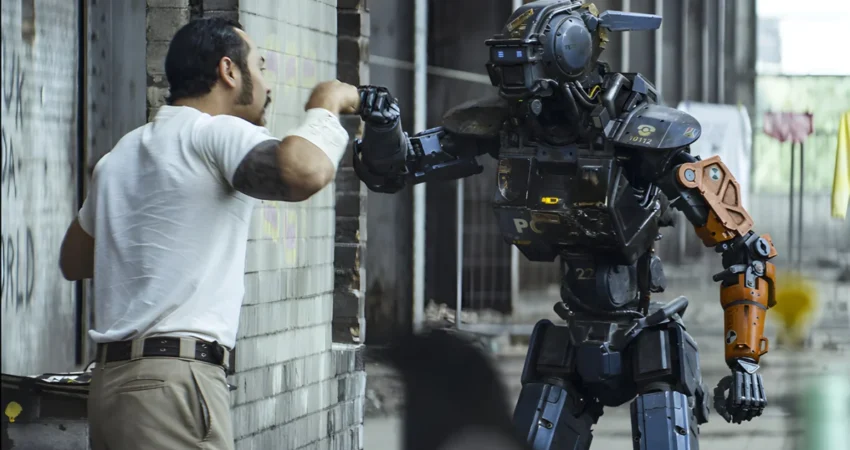
The 2015 science fiction film Chappie, directed by Neill Blomkamp, represents a pivotal moment in the cinematic exploration of artificial intelligence, blending the gritty aesthetic of near-future realism with profound philosophical inquiries into the nature of consciousness. Set against the backdrop of a crime-ridden Johannesburg, South Africa, the film follows the journey of a discarded police droid that becomes the first machine with the ability to think and feel for itself. Despite a polarizing reception upon its initial release, Chappie has undergone a significant critical revaluation in recent years, standing as a cornerstone of Blomkamp’s "social sci-fi" trilogy, which also includes the Academy Award-nominated District 9 and the dystopian epic Elysium.
The Narrative Framework and Conceptual Origins
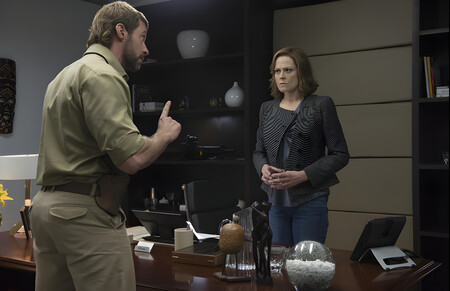
The story of Chappie is rooted in a world where law enforcement has been outsourced to a fleet of autonomous robotic scouts. Developed by engineer Deon Wilson, played by Dev Patel, these machines are programmed to uphold the law with clinical efficiency. However, Wilson’s true ambition lies beyond mere automation; he seeks to create a program capable of true sapience. When he successfully develops an artificial intelligence that can learn, create art, and experience emotion, he is denied the opportunity to test it by his corporate superior, Michelle Bradley, portrayed by Sigourney Weaver.
Driven by scientific curiosity, Wilson steals a damaged robot slated for destruction to use as a vessel for his new AI. The experiment takes a chaotic turn when Wilson and the robot are kidnapped by a trio of small-time criminals—Ninja, Yolandi, and Amerika—who hope to use the machine to assist in a high-stakes heist. The resulting narrative is a unique "coming-of-age" story where the robot, named Chappie, must navigate the conflicting influences of his "Maker" (Wilson) and his "parents" (the criminals), all while facing the existential threat of a rival engineer, Vincent Moore, played by Hugh Jackman.

Chronology of Development and Production
The development of Chappie began shortly after the release of Elysium, with Blomkamp drawing inspiration from his own 2004 short film, Tetra Vaal. Production was characterized by a commitment to practical effects and on-location filming in Johannesburg, a city that has become a signature setting for Blomkamp’s work.
- September 2013: Official casting began, with Sharlto Copley signed to provide the motion-capture performance for the titular character. Copley’s presence on set was vital, as it allowed the other actors to interact with a physical being rather than a digital placeholder.
- October 2013 – February 2014: Principal photography took place in South Africa. The production utilized real industrial sites and urban environments to ground the high-concept sci-fi in a tangible, "used future" reality.
- 2014 Post-Production: The visual effects team at Image Engine worked to seamlessly integrate the digital Chappie over Copley’s performance. The goal was to ensure that Chappie’s movements felt mechanical yet expressive, reflecting his evolving emotional state.
- March 6, 2015: Chappie was released in theaters globally, facing stiff competition and a critical landscape that was increasingly skeptical of Blomkamp’s stylized approach to social commentary.
Statistical Analysis of Box Office and Reception
Chappie’s performance at the box office and its reception by critics provide a complex picture of a film that struggled to find its footing during its theatrical run but eventually cultivated a dedicated following.
On a production budget of approximately $49 million, the film grossed $31.6 million in the United States and Canada and $70.5 million in other territories, for a worldwide total of $102.1 million. While the film technically doubled its production budget, the additional costs of marketing and distribution meant that Chappie was not the runaway financial success Sony Pictures had anticipated.
Critically, the film faced significant headwinds. On the review aggregator Rotten Tomatoes, Chappie holds a 32% approval rating from critics based on 230 reviews. The critical consensus at the time argued that the film’s narrative was overstuffed and that the inclusion of the South African counter-culture duo Die Antwoord (Ninja and Yolandi) was distracting. However, the audience score tells a different story, maintaining a 56% rating, with many viewers praising the emotional depth of the robot’s character arc and the high-quality visual effects.

Technical Innovation and the Villainous Turn of Hugh Jackman
One of the most significant aspects of Chappie is its contribution to the evolution of motion-capture technology. Sharlto Copley’s performance as Chappie is often cited as a masterclass in the medium. Unlike many CGI characters that feel detached from their environment, Chappie’s interactions with physical objects and human actors feel weighted and authentic. This was achieved through a "gray suit" process where Copley wore a specialized suit that allowed animators to track his every movement while maintaining the lighting and shadows of the actual set.
Furthermore, the film is notable for featuring Hugh Jackman in a rare antagonistic role. Jackman portrays Vincent Moore, a former soldier and engineer who views AI as an abomination and a threat to human morality. Moore’s creation, the "Moose"—a massive, remotely piloted urban pacification drone—serves as the physical and ideological antithesis to Chappie. Moore represents a specific brand of techno-skepticism and fragile masculinity, providing a grounded, albeit aggressive, counterpoint to the film’s more philosophical themes.
Ethical Implications and the Philosophy of the "Blank Slate"
At its core, Chappie explores the concept of tabula rasa, or the "blank slate." When Chappie is first activated, his mind is that of a child. He does not possess innate knowledge of right or wrong; instead, he learns through observation and social interaction. This raises profound ethical questions about the responsibility of creators toward their creations.
The film posits that if a machine can feel fear, pain, and joy, it should be afforded certain moral considerations. Chappie’s fear of "going to sleep" (death) and his desire to preserve his consciousness highlight the blurred lines between biological and digital life. The climax of the film, which involves the digital transfer of human consciousness into robotic bodies, pushes these implications even further, suggesting that the future of humanity may not be biological at all.
Official Responses and Director’s Reflection
In the years following the film’s release, Neill Blomkamp has been candid about his feelings regarding Chappie’s reception. In various interviews, Blomkamp has admitted that the harsh critical response was painful, as he felt the film was his most personal project. He noted that the film was intended to be a "bizarre, stylized version of reality" and that some of the criticism regarding the tone may have stemmed from a misunderstanding of his creative intent.
Industry analysts have also pointed out that Chappie was released during a period of "AI fatigue" in cinema. With films like Ex Machina and Avengers: Age of Ultron also arriving in 2015, the market was saturated with stories about sentient machines. While Ex Machina took a minimalist, intellectual approach and Age of Ultron went for large-scale spectacle, Chappie occupied a middle ground that was perhaps too unconventional for mainstream audiences at the time.
Broader Impact and Current Availability
Despite its initial hurdles, Chappie has left a lasting impact on the science fiction genre. Its influence can be seen in subsequent films and television series that explore the intersection of robotics and urban decay. The film’s "cyberpunk" aesthetic—mixing high-tech robotics with low-life environments—has become a reference point for visual storytellers.
The film has also benefited from the rise of streaming platforms. By being available on services such as Netflix and HBO Max, Chappie has reached a new generation of viewers who are perhaps more receptive to its unique blend of action, philosophy, and South African culture. On these platforms, the film frequently trends within the top ten most-watched movies, indicating a sustained interest that far outlives its theatrical window.

In the context of today’s rapidly advancing real-world AI, Chappie feels more relevant than ever. As we grapple with the development of Large Language Models and autonomous systems, the film’s questions about the "soul" of a machine and the ethics of programming consciousness are no longer confined to the realm of fiction. They are the very questions defining our current technological era.
Conclusion
Chappie remains a daring, if flawed, experiment in science fiction filmmaking. It is a movie that refuses to play it safe, opting instead for a gritty, emotional, and often uncomfortable look at what it means to be alive. Through the lens of a discarded robot in Johannesburg, Neill Blomkamp challenged audiences to look past the metal and circuitry to find a reflection of our own humanity. Whether viewed as a cautionary tale or a vision of digital evolution, the film’s legacy as a misunderstood gem of the 2010s is firmly established, inviting viewers to revisit the streets of South Africa and witness the birth of a new kind of life.

0 Comments