
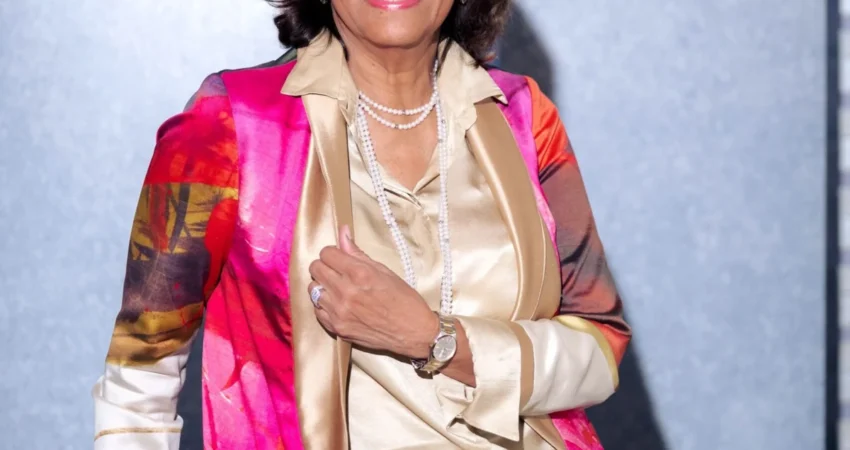
The Panamanian art world recently gathered to witness a profound reflection on the nature of creative identity as Olga Sinclair, one of the region’s most celebrated plastic artists, took the stage at the Vogue Leaders Panama 2026 summit. Presented by Frederique Constant, the event served as a platform for Sinclair to dissect her nearly seven-decade journey, moving beyond her reputation as a second-generation master to establish her standing as a global authority on abstract expressionism and cultural leadership. At 69 years of age, Sinclair continues to challenge the boundaries of the canvas, asserting that the evolution of an artist is a perpetual struggle between the weight of history and the necessity of personal reinvention.
The Evolution of a Contemporary Master
Olga Sinclair’s career is inextricably linked to the trajectory of modern art in Panama, yet her narrative is defined by a deliberate departure from the shadow of her father, the late Alfredo Sinclair. Alfredo, a pioneer of Panamanian modernism who introduced abstract expressionism to the Isthmus, provided the foundational environment for Olga’s development. Starting at the age of six, Sinclair began her formal apprenticeship in her father’s studio, learning the rigorous technical requirements of composition, canvas preparation, and the chemistry of pigments long before she engaged with the conceptual theories of the art world.
This early immersion created a dual reality for the young artist. While she gained a technical proficiency that far outpaced her peers, she also faced immediate skepticism. Upon her debut exhibition at the age of 18, critics and attendees frequently suggested that her father had intervened in her work, citing the "excessive" quality of the pieces as evidence of a veteran’s hand. This skepticism became the primary catalyst for her relocation to Europe, a move that would eventually secure her independent legacy.

A Chronology of Global Influence and Artistic Maturity
The development of Sinclair’s signature style can be traced through a series of international residencies that reshaped her perspective on light, form, and color. Each geographical shift provided a new layer to her aesthetic vocabulary:
- The Madrid Years (Real Academia de Bellas Artes de San Fernando): Moving to Spain allowed Sinclair to measure her talent against the European canon. Immersing herself in the Museo del Prado, she studied the works of Goya, Velázquez, and El Greco. It was here that she received her first external validation, as instructors recognized her innate "force" and "facility" for painting, independent of her surname.
- The London and Holland Period: Her time in London introduced her to the visceral, often unsettling works of Francis Bacon, which expanded her understanding of emotional depth in art. Subsequently, living in the Netherlands allowed her to study Rembrandt’s mastery of chiaroscuro, an influence that remains visible in her treatment of light today.
- The Bolivian Altiplano: In her 30s, Sinclair relocated to La Paz, Bolivia. At an altitude of 4,000 meters, the lack of atmospheric humidity and the distinct, sharp quality of the Andean light fundamentally altered her palette. The ochres and earth tones of the Bolivian landscape began to dominate her work, marking a period of significant commercial and critical success. It was during this time that her work gained international market traction, highlighted by a $6,000 sale at a Christie’s auction—a significant milestone for a Latin American female artist in that era.
Technical Mastery and the Philosophy of the "Sinclair Grey"
Central to Sinclair’s technical discourse is her specific use of grey, a color she views not as a symbol of melancholy, but as the essential structural foundation of a painting. Influenced by her father’s extensive library of art history, she adopted the classical view that an artist who masters grey masters the medium itself.
In her current work, which often features vibrant reds and aggressive abstractions, the "Sinclair Grey" serves as a balancing agent. She describes it as the "counterpoint" that allows primary colors to achieve their maximum resonance without overwhelming the composition. This commitment to balance is a recurring theme in her recent output, which she described at the summit as being "outside of time." While her education was rooted in academic drawing and the human figure, her contemporary work seamlessly integrates these figurative roots within an abstract framework, allowing for a dialogue between her classical training and her modern sensibilities.
The Intersection of Art and Commerce: The Harvard Influence
A unique facet of Sinclair’s career is her proactive approach to the business of art, a rarity in a field often characterized by a disdain for commercial literacy. Encouraged by her mother, who managed Alfredo Sinclair’s estate with business acumen, Olga enrolled in a specialized management program conducted in Panama by professors from Harvard University.

This education provided her with the tools to navigate the global art market, understand the valuation of her intellectual property, and maintain control over her career trajectory. Sinclair has even engaged in the strategic repurchasing of her own earlier works from private collectors, viewing them as both emotional milestones and financial assets. This intersection of creative passion and administrative discipline has allowed her to sustain a career that spans over 50 years without succumbing to the common pitfalls of the "starving artist" trope.
Cultural Leadership and the Broader Impact of the Sinclair Foundation
While the Vogue Leaders Panama 2026 event focused on her personal journey, Sinclair’s role as a leader is most visible through her philanthropic work. The Olga Sinclair Foundation (Fundación Olga Sinclair) has become a cornerstone of Panamanian cultural education, aiming to foster social transformation through art. By organizing mass painting events—some of which have set Guinness World Records for the number of participants—Sinclair has sought to democratize art, bringing the studio experience to thousands of children across the country.
During her panel, "The Art of a Passion that Transcends Time," Sinclair addressed the concept of leadership with characteristic humility. She argued that leadership in the arts is meaningless if it is not accompanied by a commitment to the next generation and a sense of "simplicity." For Sinclair, the true mark of a leader is not the accolades or the auction prices, but the ability to remain "comfortably humble" while navigating the complexities of fame and creative expectation.
Broader Implications for Latin American Art
Sinclair’s continued relevance at nearly 70 years of age reflects a broader trend in the global art market: the rising valuation and recognition of Latin American female modernists. Her ability to bridge the gap between the mid-century modernism of her father and the contemporary abstract movements of the 21st century positions her as a vital link in the region’s cultural history.

Her participation in the Vogue Leaders summit underscores the growing importance of Panama as a hub for cultural and intellectual exchange in Central America. As the country continues to invest in its creative economy, figures like Sinclair provide a blueprint for how artists can maintain regional roots while achieving global reach.
Conclusion: The Transcendence of Time in Abstract Narrative
As the summit concluded, the image of Olga Sinclair remained that of an artist still capable of being moved to tears by the successful balance of a finished canvas. Her message to the audience was one of relentless self-interrogation. By viewing herself as her own "worst enemy" and harshest critic, she has managed to avoid the stagnation that often accompanies long-term success.
Olga Sinclair’s journey from a child in a Panamanian studio to a global icon is a testament to the power of disciplined evolution. Her work continues to serve as a bridge—between the figurative and the abstract, between the business of art and the purity of creation, and between the legacy of the past and the possibilities of the future. In the world of Olga Sinclair, time does not exist when the music is playing and the brush is in hand; there is only the perpetual search for the perfect grey and the next great challenge on the horizon.

0 Comments