
The arrival of Formula 1 in Madrid has transcended the boundaries of motorsport, establishing itself as a premier venue for international fashion and high-society visibility. While the roar of the engines and the technical prowess of the drivers remain the primary draw, the paddock has evolved into a high-stakes runway where style choices are scrutinized with the same precision as a pit stop. During the recent festivities surrounding the Grand Prix, the Spanish Royal Family made a significant appearance, with Princess Leonor and Infanta Sofía capturing global attention through their curated sartorial selections. Their presence at the event, alongside King Felipe VI, served a dual purpose: reinforcing the Crown’s support for Spain’s burgeoning sports infrastructure and setting a new benchmark for contemporary royal fashion.
The Strategic Importance of the Madrid Grand Prix
The Madrid Formula 1 Grand Prix represents a pivotal shift in the landscape of European racing. Scheduled to be hosted at the IFEMA Madrid circuit starting in 2026, the event is projected to generate an annual economic impact of approximately €450 million for the Spanish capital. Beyond the financial metrics, the race serves as a soft-power tool, positioning Madrid as a global hub for luxury, technology, and tourism. The participation of the Royal Family in promotional and inaugural events underscores the national significance of this project.

King Felipe VI, a known enthusiast of Spanish sporting excellence, was joined by his daughters, the Princess of Asturias and the Infanta Sofía, to meet with the nation’s premier racing icons, Fernando Alonso and Carlos Sainz. This meeting of two of Spain’s most recognizable "brands"—the Royal House and its elite athletes—provided a visual representation of national pride. For the Princess and the Infanta, the event was also an opportunity to demonstrate a modern, accessible approach to royal dressing that resonates with a younger, fashion-conscious demographic.
Princess Leonor: An Analysis of the Strawberries and Cream Aesthetic
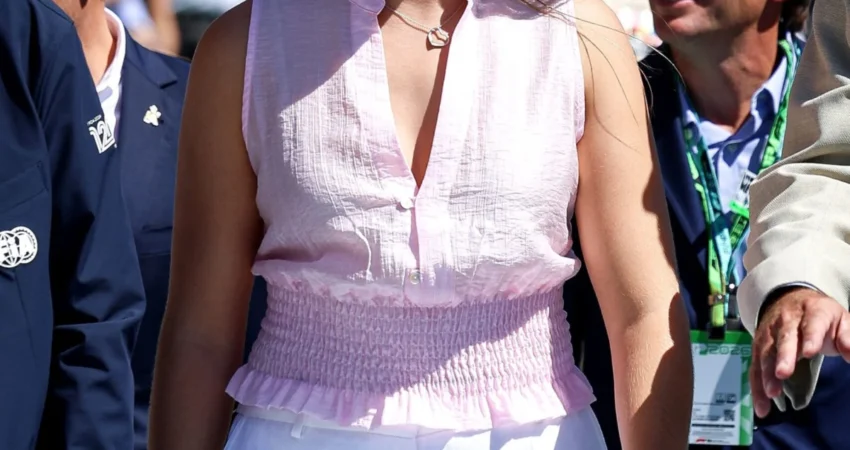
Princess Leonor’s choice of attire for the occasion has been described by fashion analysts as the "strawberries and cream" look, a color palette that is predicted to dominate the 2025 and 2026 seasons. The ensemble was a masterclass in balancing traditional royal modesty with current "Boho-Chic" trends. The centerpiece of her look was a fluid, rose-pink blouse featuring bohemian-inspired details. This specific shade of pink—somewhere between dusty rose and a vibrant berry—has seen a resurgence on international runways, moving away from the "Barbiecore" trend toward a more muted, sophisticated romanticism.
To complement the blouse, the Princess opted for white palazzo pants, a garment that has become a staple of "quiet luxury." The palazzo silhouette, characterized by its high waist and wide, flowing leg, offers a functional yet elegant alternative to more restrictive formal wear. Historically, the palazzo pant gained popularity in the 1960s and 70s as a symbol of feminine liberation and effortless chic. By integrating this piece into her wardrobe, Princess Leonor aligns herself with a timeless aesthetic that prioritizes comfort without sacrificing stature.

The look was rounded out with a matching white handbag, maintaining a clean, two-tone color story. This "strawberries and cream" combination—pink and white—is noted for its ability to provide a luminous effect, brightening the wearer’s complexion while maintaining a soft, approachable aura. In the context of a high-energy sports event, the outfit stood out for its freshness and simplicity, contrasting with the often-aggressive branding seen in the F1 paddock.
Infanta Sofía and the Power of Monochromatic Romanticism
While her sister embraced a dual-tone palette, Infanta Sofía leaned into the monochromatic trend, a styling technique often used to create a streamlined, elongated silhouette. Her choice of an all-white ensemble featured a romantic-style shirt with delicate detailing, paired with the same trending palazzo trousers favored by the Princess. The Infanta’s look emphasized a "total white" aesthetic, which remains a perennial favorite for summer-to-autumn transitions in Mediterranean climates.
To break the uniformity of the white, Infanta Sofía utilized accessories in "café" or earth tones. This subtle use of brown leather accents—likely in the form of a belt or footwear—added a grounded, equestrian-adjacent touch to the outfit. Fashion historians often point to the all-white look as a symbol of status and purity, but in the modern context, it serves as a versatile canvas for personal expression. The Infanta’s ability to coordinate with her sister while maintaining a distinct personal style highlights the evolving fashion identities of the two royals as they transition into adulthood.

Broader Paddock Trends: From Desigual to Christopher Esber
The Royal Family’s style was part of a broader tapestry of fashion excellence at the Madrid event. The paddock featured a diverse array of looks, ranging from avant-garde Spanish designs to minimalist international labels. Alexandra Leclerc drew headlines in a vibrant dress by Desigual, a brand synonymous with Barcelona’s eclectic and artistic spirit. The choice of Desigual served as a nod to Spanish retail success and the bold, pattern-heavy aesthetic that defines much of the country’s contemporary fashion scene.
In contrast, Rebecca Donaldson, partner of driver Carlos Sainz, opted for a more minimalist approach. She was seen in a white minidress with red stripes and intricate lace details by Australian designer Christopher Esber. Esber is renowned for his "deconstructed" silhouettes and technical precision, and the choice of his label reflects the growing influence of niche, high-end designers within the F1 social circle. These varied looks illustrate that the F1 paddock is no longer just a space for team uniforms and technical gear; it is a competitive arena for global fashion influence.
Chronology of Royal Fashion Evolution
The style witnessed at the Madrid Grand Prix is the result of a multi-year evolution in the way the Spanish Royal House approaches public appearances.

- 2018–2021: A period of "protected" style, where the Princess and Infanta were often dressed in matching or highly similar traditional dresses, emphasizing their youth and unity.
- 2022–2023: A transition toward "High Street" brands. The sisters began incorporating pieces from accessible Spanish retailers like Zara and Mango, signaling a move toward relatability during a time of global economic shifts.
- 2024–Present: The "Individual Identity" phase. The current era sees the sisters choosing distinct silhouettes—such as Leonor’s preference for boho-chic and Sofía’s inclination toward romantic minimalism—while still adhering to a cohesive family brand.
This chronological shift is strategic. By adopting current trends like the palazzo pant and the "strawberries and cream" color story, the Royal House ensures that its image remains modern and relevant to a generation that consumes news via visual platforms like Instagram and TikTok.
The Economic and Cultural "Royal Effect"
The impact of Princess Leonor and Infanta Sofía’s fashion choices extends beyond mere aesthetics; it has a tangible effect on the retail industry. This phenomenon, often termed the "Royal Effect," frequently leads to specific items selling out within hours of a public appearance. By choosing Spanish-inspired styles and colors, the sisters act as unofficial ambassadors for the national textile industry, which accounts for approximately 2.8% of Spain’s GDP.
Furthermore, their appearance at a Formula 1 event helps bridge the gap between traditional institutions and modern entertainment. As Formula 1 continues to expand its reach—driven largely by the success of docuseries like Drive to Survive—it has attracted a younger, more female-skewed audience. The presence of the Princess and the Infanta provides a relatable touchpoint for this new demographic, merging the world of hereditary tradition with the fast-paced world of elite motorsport.

Looking Ahead: Seasonal Transitions and Lasting Implications
As the fashion world looks toward the autumn/winter 2024 and 2025 seasons, the looks debuted at the Madrid Grand Prix provide a roadmap for transitional dressing. The combination of pink and white, while traditionally associated with warmer months, is being reimagined for cooler weather. Analysts suggest that the boho blouse and palazzo pant can be easily adapted for autumn by swapping sandals for coffee-colored ankle boots and adding structured outerwear, such as a camel coat or a tailored blazer.
The enduring appeal of these outfits lies in their balance. They are trendy enough to be "current" but classic enough to avoid becoming dated in the historical record. As Princess Leonor prepares for her future role as Queen, her fashion choices are increasingly viewed as part of her diplomatic toolkit—a way to communicate stability, modernity, and national pride without saying a word.
In conclusion, the Madrid Formula 1 Grand Prix has proven to be more than a race; it is a cultural milestone. Through their sophisticated use of color, silhouette, and brand selection, Princess Leonor and Infanta Sofía have confirmed their status as influential figures in the European fashion landscape. Their "strawberries and cream" and "total white" ensembles did more than just capture the cameras; they set the tone for a new era of royal style that is as dynamic and forward-looking as the cars on the track.

0 Comments