
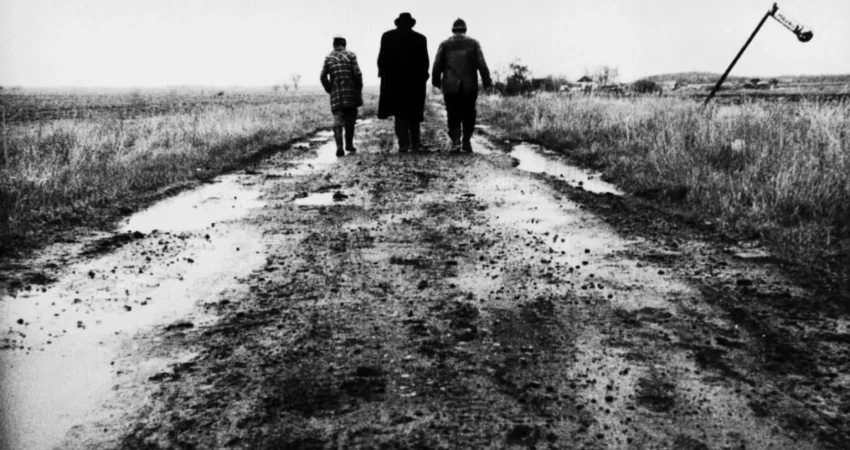
The landscape of contemporary cinema is often defined by rapid editing, concise runtimes, and immediate narrative gratification, yet Béla Tarr’s 1994 magnum opus, Sátántangó, stands as a monolithic antithesis to these modern conventions. Spanning over seven hours and fifteen minutes, the film is not merely a motion picture but a durational experience that challenges the viewer’s perception of time, space, and human despair. From its opening moments—a legendary eight-minute continuous shot of a herd of cattle wandering through a bleak, mud-caked collective farm—the film establishes a hypnotic and inhospitable atmosphere that persists until its final frame. This sequence, filmed without a single cut, serves as a gateway into a world defined by the collapse of the Eastern Bloc, the decay of the human spirit, and the cyclical nature of betrayal.
The Genesis and Literary Foundation of a Cinematic Giant
Sátántangó is based on the 1985 novel of the same name by László Krasznahorkai, a writer known for his dense, labyrinthine prose and bleak philosophical outlook. The collaboration between Krasznahorkai and director Béla Tarr is one of the most significant in film history, as Tarr found in the author’s work a visual language for the "end of history." The film was not a sudden creation; it required years of planning and a grueling production schedule that mirrored the stagnant, rainy environment it sought to depict.
Set in a failing agricultural collective in rural Hungary, the narrative follows a small group of villagers who have lost all sense of purpose. Their lives are characterized by petty squabbles, alcoholism, and a profound lack of hope. The catalyst for the story is the rumored return of Irimiás, a charismatic and manipulative figure played by Mihály Víg, who also composed the film’s haunting, repetitive score. Irimiás, long thought to be dead, arrives as a self-styled messiah, promising the villagers a new beginning while secretly operating as a police informant and a con artist.
Narrative Structure: The Twelve Steps of the Tango
The film’s title, which translates to "Satan’s Tango," refers to the specific narrative structure employed by both the novel and the film. The story is divided into twelve distinct chapters, mirroring the steps of a tango: six steps forward, and six steps back. This structure allows the film to revisit the same events from multiple perspectives, creating a non-linear sense of time where the characters are trapped in a loop of their own making.
This "circularity" is central to the film’s theme of stagnation. In one chapter, we might see a character observing a distant light; in a later chapter, we experience the events occurring at the source of that light. This overlapping chronology emphasizes the isolation of the characters—they are physically close but emotionally and spiritually miles apart. The twelve chapters are:
- The News of Their Arrival
- The Resurrection
- Waiting
- The Work of the Spider I
- The Work of the Spider II (The Web)
- The Coming
- Irimiás’ Speech
- The Perspective from the Front
- The Perspective from the Back
- The Perspective from the Side
- The Departure
- The Circle Closes
By the time the "tango" concludes, the audience has witnessed a complete erosion of the community’s remaining dignity, leaving only the desolate landscape and the relentless sound of rain.
Technical Mastery and the Philosophy of the Long Take
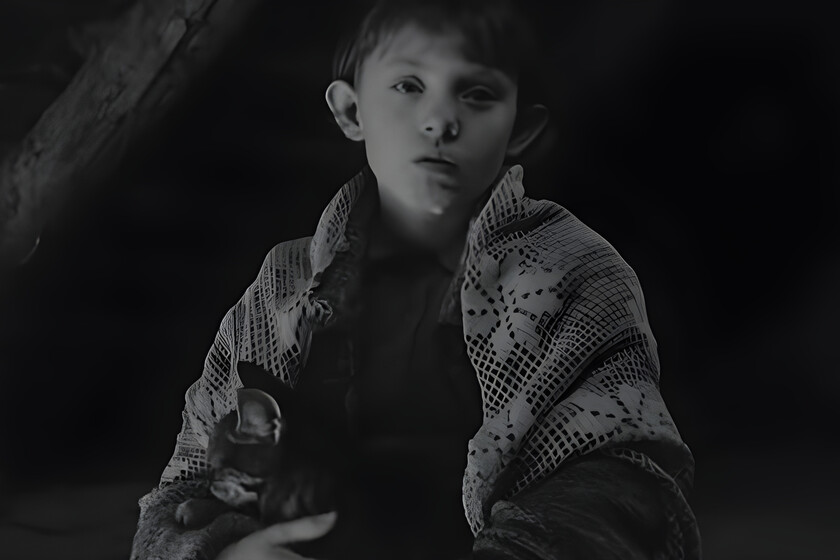
What distinguishes Sátántangó from other long-duration films is its technical execution. Béla Tarr, alongside cinematographer Gábor Medvigy, utilized approximately 150 shots for the entire seven-hour runtime. In comparison, a standard two-hour Hollywood film often contains between 2,000 and 3,000 cuts. This reliance on the "long take" forces the audience to inhabit the space alongside the characters.
The film’s cinematography is characterized by slow, deliberate tracking shots that follow characters through muddy streets or across barren plains. These shots are not merely stylistic choices; they are a philosophical commitment to "real time." Tarr has frequently stated that he is less interested in plot than in the "dignity of the people" and the textures of the world they inhabit. The black-and-white photography captures every drop of rain, every puff of cigarette smoke, and every wrinkle on the actors’ faces with a stark, high-contrast clarity that elevates the mundane to the level of the epic.
Critical Reception and the Scorsese Endorsement
Despite its intimidating length, Sátántangó has maintained a legendary status among critics and filmmakers. It currently holds a rare 100% approval rating on the review aggregator Rotten Tomatoes, a testament to its enduring impact. When it premiered at the Berlin International Film Festival in 1994, it was immediately recognized as a landmark of world cinema.
One of the film’s most vocal proponents is the Academy Award-winning director Martin Scorsese. Known for his own kinetic and fast-paced style, Scorsese has nonetheless praised Tarr’s work for its meditative power. In various interviews and essays, Scorsese has described Sátántangó as one of the most "profoundly transformative" experiences available to a lover of cinema. He noted that Tarr’s films are "authentic experiences that one absorbs and that continue to develop in the mind."
The late Susan Sontag, one of the 20th century’s most influential critics, famously remarked that she would be "glad to see it every year for the rest of my life." Such high praise from cinematic luminaries has helped the film survive in the cultural consciousness, despite its lack of commercial viability.
Socio-Political Context: Hungary in the Wake of Communism
To fully understand Sátántangó, one must consider the historical context of its creation. Released in 1994, the film arrived during a period of profound transition for Hungary. Following the collapse of the Soviet Union and the end of communist rule in 1989, many rural communities in Eastern Europe found themselves in a state of economic and social limbo.
The collective farm in the film serves as a microcosm for this post-communist malaise. The state-run systems had failed, but the promised prosperity of capitalism had yet to arrive. This left a vacuum filled by opportunists like Irimiás, who exploited the people’s desperation for a leader. The film’s themes of power, the absence of the state, and the decay of social structures are deeply rooted in the reality of 1990s Hungary, making it as much a historical document as it is a work of fiction.
Broader Impact and the Legacy of "Slow Cinema"
Sátántangó is often cited as the definitive work of the "Slow Cinema" movement, a style characterized by long takes, minimalism, and an emphasis on atmosphere over traditional plot. Its influence can be seen in the works of contemporary directors such as Gus Van Sant (particularly in his "Death Trilogy"), Apichatpong Weerasethakul, and Lav Diaz.
The film’s legacy is also tied to its physical demands on the audience. Viewing Sátántangó is often treated as a rite of passage for cinephiles. Many independent theaters that screen the film include multiple intermissions, turning the screening into a day-long event. This collective experience of "enduring" a film creates a unique bond between the audience and the work, one that is impossible to replicate in the era of "snackable" content and short-form video.
Availability and the Challenges of Access
For modern viewers, accessing Sátántangó remains a challenge, particularly in regions like Mexico where it is not available on mainstream streaming platforms. The film’s length and niche appeal make it a difficult acquisition for services like Netflix or HBO Max, which prioritize high-turnover content.
However, the film has seen a resurgence in interest due to high-quality physical media releases. A 4K restoration by Arbelos Films has ensured that the film’s visual splendor is preserved for future generations. For those in Mexico and other regions, importing the Blu-ray through retailers like Amazon remains the most reliable way to experience the film in its intended quality.
Conclusion: A Monument to Human Persistence
Sátántangó is a film that demands everything from its audience: their time, their patience, and their emotional stamina. In return, it offers a vision of humanity that is unparalleled in its honesty and scope. It does not look away from the ugliness of life, nor does it offer easy consolations. Instead, it presents the world in all its stagnant, muddy, and beautiful complexity.
As Martin Scorsese suggested, it is a film that "stays with you." Long after the seven hours have passed and the screen has gone dark, the images of the wind-swept plains and the sound of Mihály Víg’s accordion continue to resonate. Sátántangó remains a vital reminder of what cinema can achieve when it refuses to compromise, standing as a permanent monument to the power of the moving image.

0 Comments