
The global cinematic landscape is currently bracing for the arrival of Avengers: Doomsday, a landmark entry in the Marvel Cinematic Universe (MCU) that promises to redefine the franchise’s trajectory. With only 15 weeks remaining until the film’s highly anticipated premiere, audiences are being encouraged to revisit the foundational pillars of the saga. To understand the stakes of the upcoming conflict involving Doctor Doom, one must look back over a decade to the film that fundamentally altered the industry: The Avengers (2012). Directed by Joss Whedon, this production served as the grand finale of Marvel’s Phase 1, marking the first time in history that a multi-franchise crossover succeeded on such a massive financial and critical scale. Today, it remains a touchstone for the genre, having been the first MCU entry to surpass the $1 billion threshold and establishing a blueprint for serialized storytelling that every major studio has since attempted to replicate.
The Genesis of a Cinematic Revolution: A Chronology of Phase 1
The road to the 2012 assembly was a calculated risk orchestrated by Marvel Studios President Kevin Feige. Before the "Earth’s Mightiest Heroes" could share the screen, the studio had to build a rapport between the audience and individual protagonists. This journey began in 2008 with Iron Man, a film that revitalized Robert Downey Jr.’s career and introduced the concept of the post-credits scene as a narrative bridge. This was followed by The Incredible Hulk (2008), which, despite a softer box office performance, established the existence of S.H.I.E.L.D. and the "Avengers Initiative."

By 2010 and 2011, the universe expanded rapidly. Iron Man 2 introduced Black Widow (Scarlett Johansson) and further developed the bureaucracy of superheroism. Thor brought a cosmic dimension to the franchise, introducing the God of Mischief, Loki (Tom Hiddleston), who would become the primary antagonist of the 2012 team-up. Finally, Captain America: The First Avenger provided the moral compass of the team and introduced the Tesseract, an artifact of immense power that would serve as the catalyst for the events in New York. The 2012 film was not merely a sequel; it was the convergence of five distinct storylines, a feat of narrative engineering that had never been successfully executed in Hollywood history.
Narrative Architecture and the Battle of New York
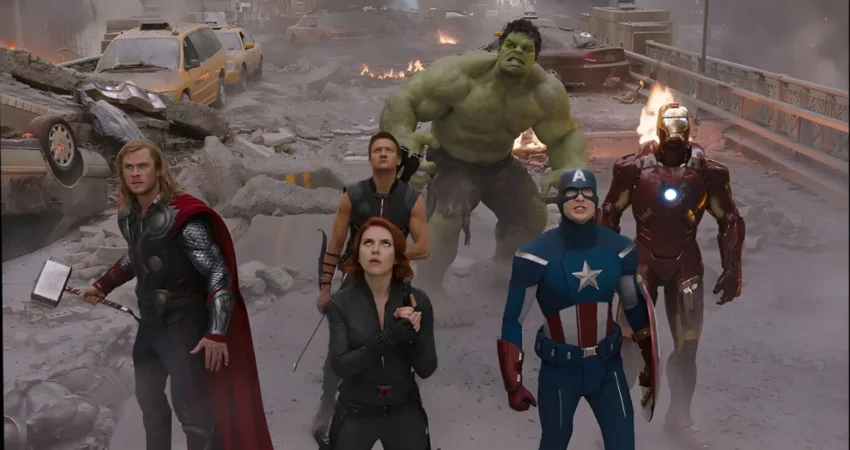
The plot of The Avengers (2012) centers on the theft of the Tesseract by Loki, who acts as a vanguard for a mysterious alien force known as the Chitauri. Nick Fury (Samuel L. Jackson), Director of S.H.I.E.L.D., is forced to activate the Avengers Initiative, bringing together a volatile group of individuals: Tony Stark (Iron Man), Steve Rogers (Captain America), Bruce Banner (The Hulk), Thor, Natasha Romanoff (Black Widow), and Clint Barton (Hawkeye).
The film’s brilliance lay in its focus on internal conflict. The protagonists did not initially function as a team; they were a collection of "monsters" and "relics" with clashing ideologies. The turning point—the death of Agent Phil Coulson—served as the emotional "push" needed to unify them. This led to the iconic Battle of New York, a third-act set piece that set a new standard for visual effects and action choreography. The "circular shot" of the six heroes standing together in the ruins of Grand Central Terminal remains one of the most recognizable frames in modern cinema, symbolizing the official birth of the team.

Statistical Dominance and Industry Impact
The financial performance of The Avengers was nothing short of a phenomenon. Upon its release in May 2012, it shattered domestic opening weekend records, earning $207.4 million in its first three days in the United States. It eventually concluded its theatrical run with a global total of over $1.518 billion, making it the third highest-grossing film of all time at that period.
The film’s success was mirrored by its critical reception. On the review aggregator Rotten Tomatoes, the film maintains a 91% approval rating from both critics and audiences. Critics praised the film for balancing its large ensemble cast and maintaining a sense of humor without sacrificing the stakes. From a business perspective, the success of The Avengers signaled to the industry that the "Shared Universe" model was viable. This led to a decade of competing studios attempting to launch their own interconnected franchises, from the DC Extended Universe to the Dark Universe, though few managed to capture the same synergy.
The Doomsday Connection: A Fifteen-Film Homework List
As Marvel Studios prepares for Avengers: Doomsday, the narrative importance of the 2012 film has been revitalized. Marvel recently confirmed a curated list of 15 essential productions that fans should watch to fully grasp the context of the upcoming Multiverse-spanning conflict. The Avengers holds a prestigious spot as the fourth entry on this list, following X-Men, X-Men 2, and Captain America: The First Avenger.

The inclusion of the 2012 film is significant because it introduced the first hint of Thanos in its mid-credits scene, setting a decade-long narrative in motion. As the franchise moves toward Doomsday, which features Robert Downey Jr. returning to the MCU—not as Tony Stark, but as the villainous Victor von Doom—the parallels to the original team-up are striking. The Avengers represented the first time the world had to defend itself against a cosmic threat; Doomsday will likely represent a threat to the very fabric of reality itself. By revisiting the 2012 film, audiences are reminded of the origins of the team’s dynamics and the high cost of global defense.
Official Perspectives and Production Insights
Reflecting on the film’s legacy, Kevin Feige has often noted that The Avengers was the moment the studio knew the "long game" was working. In various retrospective interviews, the production team has discussed the difficulty of balancing the "human" elements with the "superhuman" action. The decision to cast Mark Ruffalo as Bruce Banner/The Hulk, replacing Edward Norton, was initially met with skepticism but eventually became one of the film’s most lauded elements, as Ruffalo brought a weary, soulful intelligence to the role.
Furthermore, the film’s influence on the current "Multiverse Saga" cannot be overstated. The Battle of New York has been revisited in Avengers: Endgame through time travel and mentioned in numerous Disney+ series like Hawkeye and Loki. It is the "ground zero" event for the MCU, the moment the public became aware of aliens and gods. Analysts suggest that Avengers: Doomsday will likely reference these early days to heighten the emotional stakes of the new conflict, potentially contrasting the hope of the original assembly with the "doom" brought by the new antagonist.

Broader Implications for the Future of the MCU
The transition from the 2012 era to the current state of the MCU reflects the evolution of the audience’s appetite. While The Avengers was a straightforward story of heroism, the upcoming Doomsday and its successor, Secret Wars, are expected to delve into complex themes of multiversal collapse and moral ambiguity. However, the core appeal remains the same: the spectacle of seeing disparate characters forced to work together against impossible odds.
The 15-week countdown to Doomsday is more than a marketing window; it is an invitation for a new generation of fans to discover the roots of the franchise. For those following the "homework list" on Disney+, The Avengers serves as the bridge between the grounded origin stories of Phase 1 and the expansive, cosmic scale of Phase 2 and beyond. It remains the gold standard for superhero ensembles, a film that proved that with the right character development and a clear vision, the "impossible" could be achieved.
As the industry looks toward the release of Avengers: Doomsday, the shadow of 2012 looms large. The return of the Russo Brothers to the director’s chair and the casting of Robert Downey Jr. as the primary antagonist are clear signals that Marvel is looking to recapture the lightning-in-a-bottle magic of its early successes. Whether Doomsday can reach the heights of the 2012 original remains to be seen, but the foundation laid fourteen years ago ensures that the Avengers brand remains the most potent force in global entertainment. For fans and critics alike, the journey back to the Battle of New York is not just a trip down memory lane; it is an essential step in preparing for the end of the world.

0 Comments